For human beings, light influences primarily vision and mood, whereas light intensity for plants is a determinant of whether they are capable of synthesizing nutrients, preserving their structure, and finishing their life cycle, or not. A plant with plenty of water and nutrients will still stretch, get weak or die away with lack of sufficient light.
The key lies in the fact that humans and plants perceive light in completely different ways. The green color is the most sensitive to our eyes, while red and blue colors are the dominant colors that plants use during photosynthesis. A room that feels bright to our eyes might not deliver enough useful energy for plants to yield good quality growths. Normal lamps and special grow lights vary considerably in light energy efficiency. By reading this article, you can understand the concept of light intensity for plants, find the optimal light levels for your plants, and learn some remedies for both excessive and insufficient light.
Choosing the Right Light Intensity Units
Units designed for human vision: Lux, Lumen, and Footcandles
When we assess whether a room is bright, we rely on our eyes. The human retina is most sensitive to green light and less sensitive to blue and red light. Based on this visual characteristic, scientists have defined the following units:
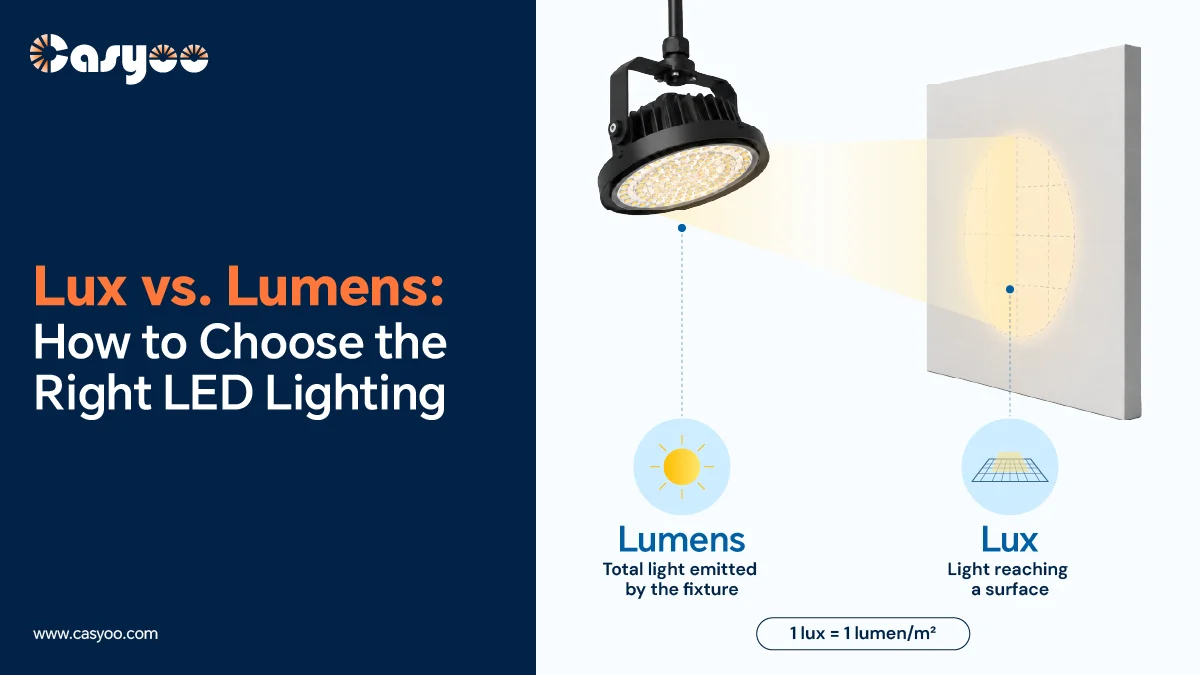
- Lumen: It is a measurement of how much total visible light is being emitted from a source. It is equal to the amount of light that a bulb emits that our eyes can receive. It defines the “source” and not “how many of it hit a surface.”
- Lux: This is more useful and popular. A lux is equal to one lumen of light uniformly spread over a square meter of area. It is a measure of how many times light falls on a surface—such as your desk—basically the “illuminance” of that space.
- Footcandles (FC): This is the same concept as lux, but using imperial units. One footcandle equals one lumen evenly spread over one square foot.
In short, lumens indicate “how bright the bulb is,” while lux and footcandles indicate “how bright the surface is.” Inasmuch as one square meter is approximately 10.76 square feet, for conversion between lux and footcandles, it is approximately 1 FC ≈ 10.76 lux.
Units designed for plant photosynthesis: PAR, PPFD, and DLI
For plants, light is not just a matter of brightness; it’s about whether there are enough photons for photosynthesis. In horticulture, a different set of measurement units is more commonly used:
- PAR (Photosynthetically Active Radiation): It is a conceptual band and not a measurement of a correct quantity. It is that band of wavelengths between 400–700 nm that can be used for photosynthesis by plants, i.e., blue and red light predominantly.
- PPFD (Photosynthetic Photon Flux Density): This is the most important unit for plant light measurement. It quantifies how many “photosynthetically active photons” (within the PAR range) land on one square meter of surface per second. Its unit is µmol/m²/s (micromoles per square meter per second).
- DLI (Daily Light Integral): It is a measurement of total photosynthetic photons that arrive every 24 hours per square meter area. It has a unit of mol/m²/day ((moles per square meter) day)). DLI, obtained as the cumulative sum of PPFD measurements, is the best indicator of a plant’s growth rate, morphology, and ultimate yield.
Correspondence of Light Intensity and Plant Growth
While we know light intensity and photosynthesis are closely related, not all plants “prefer as much light as possible.” PPFD (µmol/m²/s) is usually used as the core reference for classifying light intensity levels. Read on to learn about the best light intensity for plant growth.
Low light requirement (PPFD: 50–150 µmol/m²/s)
This level is equivalent to a bright room away from a window or under the shade of trees. Plants suited to this environment cannot tolerate strong direct sunlight, or their leaves may burn. These species are best suited to bathroom, north-light rooms that receive low light, or office decor.
Medium light requirement (PPFD: 200–400 µmol/m²/s)
This range is comparable to areas near east- or west-facing windows where soft direct light is available. Most common foliage plants and some flowering plants fall into this category. They require enough sunlight to grow healthy and have green leaves, but do not usually need full-day intense sunlight.
High light requirement (PPFD: 500–1,000 µmol/m²/s)
This light level is comparable to a south-facing sun window or greenhouse with several hours of full sun every day. Many flowering plants, fruit trees, and vegetables need this intensity to drive robust photosynthesis, accumulate energy for flowering, fruiting, and developing rich flavors. Most indoor growth of these varieties of plants would necessarily involve special growth lamps to consistently reach these light levels.
Very high light requirement (PPFD: 1,000+ µmol/m²/s)
Outdoor cultivation scenarios or professional greenhouse light intensity can be very high. This level of light intensity should be used with crops that yield many or plants that require high exposure to sunlight like corn or sunflowers.
Table Guide: Light Intensity and Suitable Plant Types
| Light Intensity (PPFD µmol/m²/s) | Light Level | Suitable Plants (Common Examples) |
| 50 – 150 | Very Low Light | Pothos, Spider Plant, Snake Plant, Monstera, Peace Lily, English Ivy, Maidenhair Fern |
| 150 – 300 | Low Light | Chinese Evergreen, Asparagus Fern, Bamboo Palm, Parlor Palm, Calathea, Money Tree |
| 200 – 400 | Medium Light | African Violet, Clivia, Mint, Basil, Parsley, Rosemary, Dumb Cane, Succulents |
| 400 – 600 | Medium-High Light | Gardenia, Kalanchoe, Strawberry, Chili Pepper, Petunia, Jasmine, Cilantro |
| 600 – 1,000 | High Light | Tomato, Cucumber, Rose, Sunflower, Lily, Dwarf Sunflower, Watermelon, Sweet Pepper |
| > 1,000 | Very High Light | Corn, Soybean, Cotton, Field Sunflower, Grape, Rapeseed, Wheat and other cereal crops |
Methods for Measuring Light Intensity for Plants
Mobile Apps
By downloading dedicated light meter apps (e.g., Lux Light Meter, Light Meter), you can read the lux value at your current location directly.
Tips: Since the smartphone camera sensor is typically small, readings can fluctuate. A trick to improve accuracy is to cover the sensor (usually near the earpiece or front camera) with a semi-transparent white sheet. This serves as a diffuser, making the reading more consistent and accurate over an area, as opposed to a point.
Apps tend to read lux, which may be approximately translated to PPFD. Under full-spectrum white light, a crude estimate is about 70 lux ≈ 1 µmol/m²/s, although this may easily change with non-full-spectrum sources.
PAR Meter
In transitioning to serious horticulture, particularly indoor greenhouses, or where a tight control over crop output is needed, investment in a PAR meter (or quantum sensor) becomes necessary. This is the only device that directly and accurately measures PPFD (µmol/m²/s).
PAR meters measure the number of photons in the 400–700 nm range, completely avoiding the errors caused by human-eye sensitivity. They give you the ability to adjust lamp height and layout to have all plants getting maximum light at their growth stage.
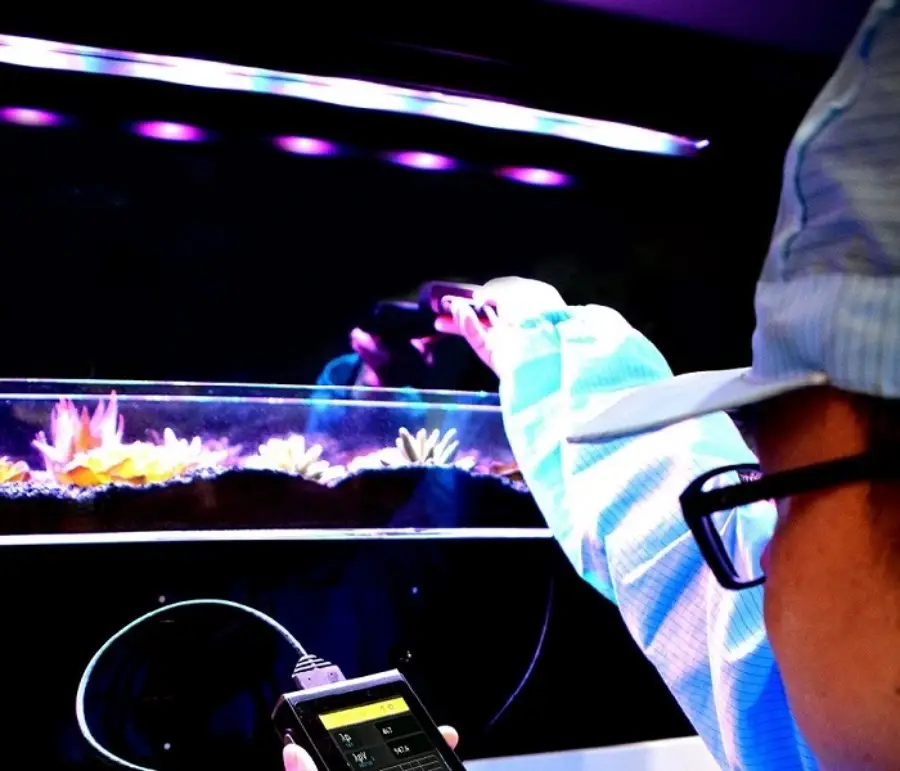
Spectrometer
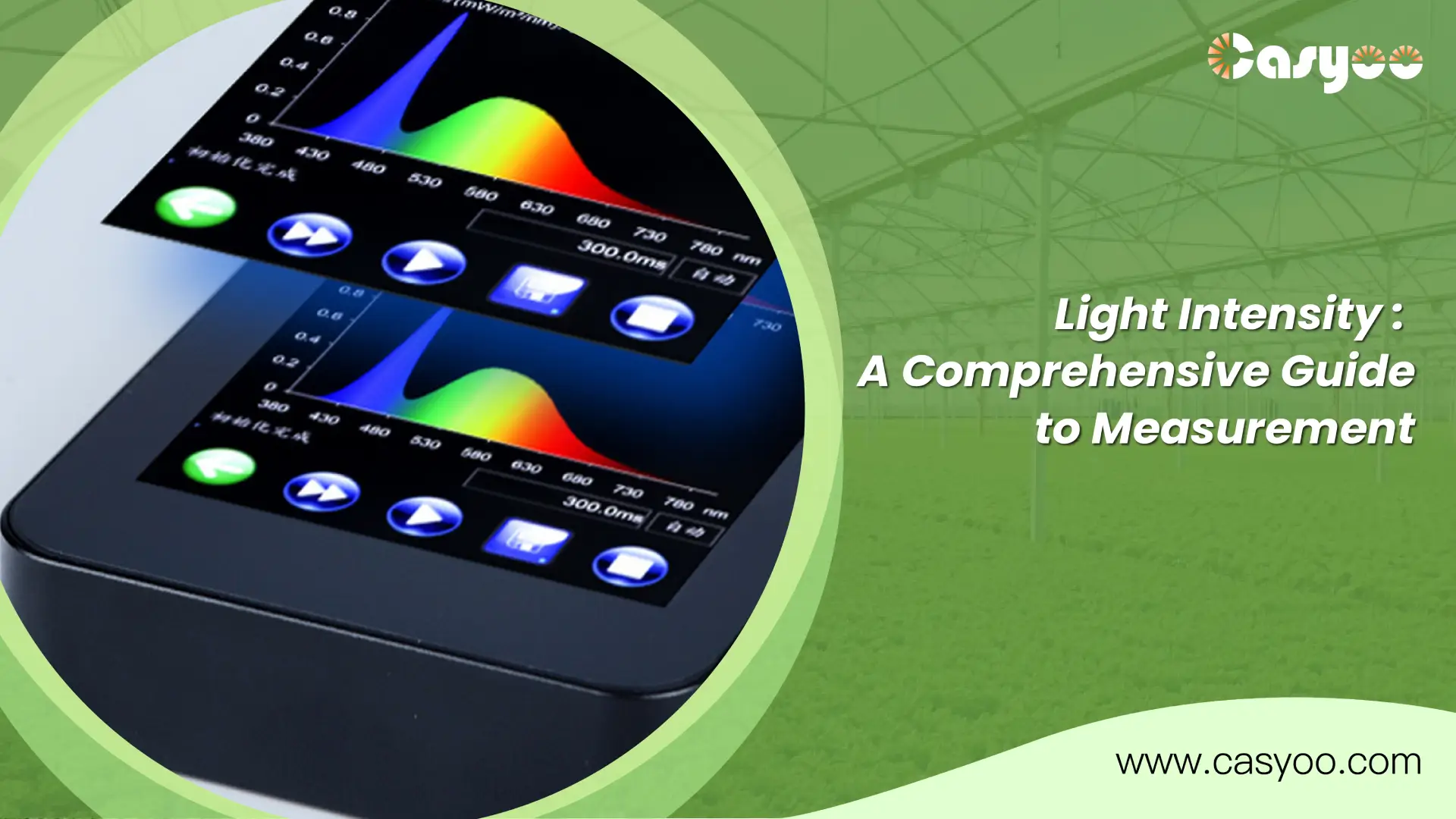
Spectrometers analyze the entire spectrum and strength of each wavelength, which gives the most detailed analysis of a light setting. But these machines are costly, complicated and mostly unnecessary to the ordinary home gardener.
Diagnosing and Remedying Light Deficiency and Excess
Light deficiency
Symptoms: When there is a lack of light, plants tend to exhibit yellowing or pale leaves, long intervals between leaves, and a general stretching of the leaves.
Remedies: The solutions are to provide more light, reduce the light time and plant placement optimization. Start by moving plants to a brighter location, such as nearer an east- or south-facing window. Introduce them slowly to the new light so as not to shock them.
Excessive light
Symptoms: Common symptoms of excess light are spots of leaf burn, curled or dry margins, pale or bleached leaves, and brown spots.
Remedies: Minimize light using shading, change lamp distance or increase dark intervals. Add shading nets, curtains or diffusing cloths or decrease lamp power where necessary. Plants that are subjected to long periods of intense light need sufficient water and nutrients to recuperate damaged tissue.
Frequently Asked Questions
How to tell if grow light is too strong?
The most obvious signs are bleached or brown spots on leaves (especially the top leaves), with the plant appearing tense or stunted, and unusually fast soil drying.
What colors of light encourage flowering?
The best light for flowering, photoperiod response regulation, controlling compact growth, and leaf development is red light (600–700 nm) and far-red light.
Can plants get too much artificial light?
Yes. Leaf burns and abnormal growth may also be caused by prolonged or excessive artificial light; therefore, the intensity and duration of the artificial light should be adjusted accordingly.