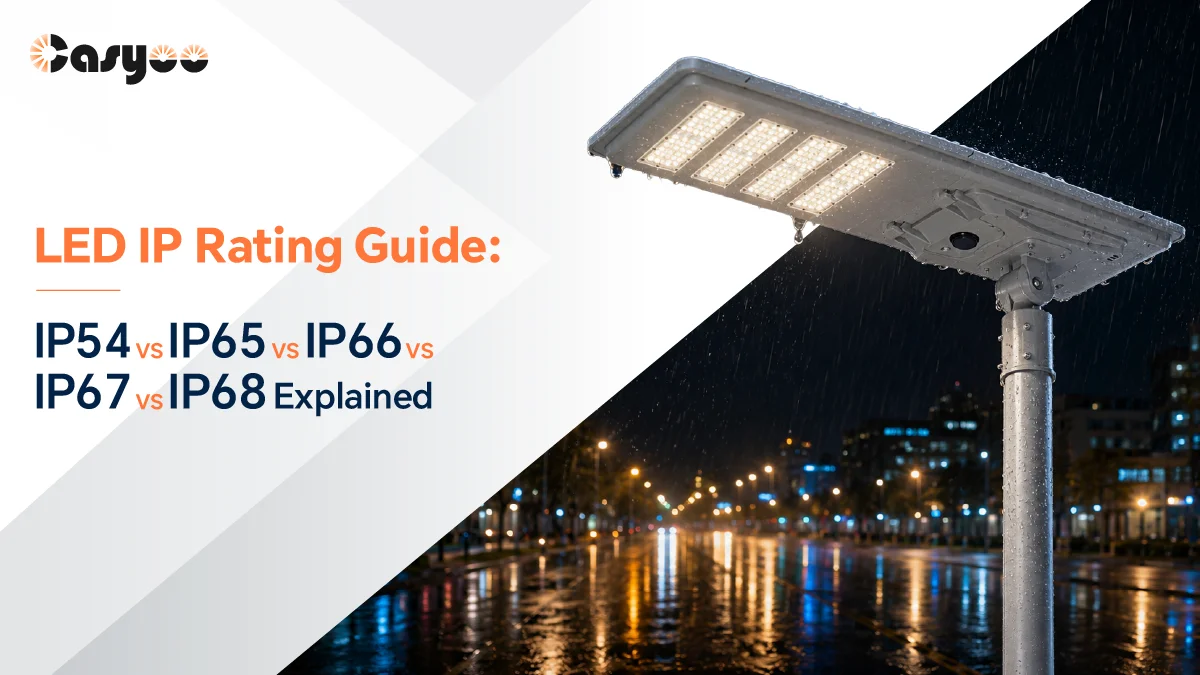
IP54, IP65, IP66, IP67, IP68 — do you know what the differences are between the IP ratings? In outdoor and industrial lighting projects, it is critical to ensure that LED fixtures are durable and resistant enough to withstand operating conditions that can sometimes be tough. Whether on building facades, in car parks or in industrial plants, LED lighting is regularly exposed to dust, rain, and moisture.
As a manufacturer of LED lighting fixtures, our products are generally used in demanding environments, requiring high levels of protection. Chances are that you’ve already heard of IP ratings, but which one is the right choice for your lighting project?
To help you decide on the right LED fixture to fit your needs, we explain the various levels of LED IP ratings, and focus on the ones most relevant to LED lighting.
What does an LED IP rating mean?
IP stands for “Ingress Protection.” IP rating is an international standardized way to describe the level of protection against solids and liquids offered by an electrical enclosure. It is defined by the International Electrotechnical Commission (IEC) and is adopted in Europe as EN 60529.
Every rated LED fixture is identified by the letters “IP” and followed by 2 digits. The first digit indicates the level of impermeability to solids (dust, tools, fingers), and the second corresponds to liquids (drips, sprays, immersion). For example, an LED street light rated IP65 is completely dust-tight (6) and protects against low-pressure water jets (5).
LED IP rating chart: first digit vs second digit
As mentioned above, protection against solids is indicated by the first digit, ranging from 0 to 6. Level 0 offers no protection at all against foreign objects. Level 6, on the other hand, means that the enclosure will be totally dust-tight.
The liquid intrusion level is represented by the second digit, which ranges from 0 to 9. Level 4 ensures that your fixture will be protected against splashing water from any direction. At level 9, it offers protection against close-range, high-pressure, high-temperature jet washing.
Note that the IP protection level certifies resistance to clear water only. Here’s a chart showing what each IP digit means, so you can get a clear understanding.
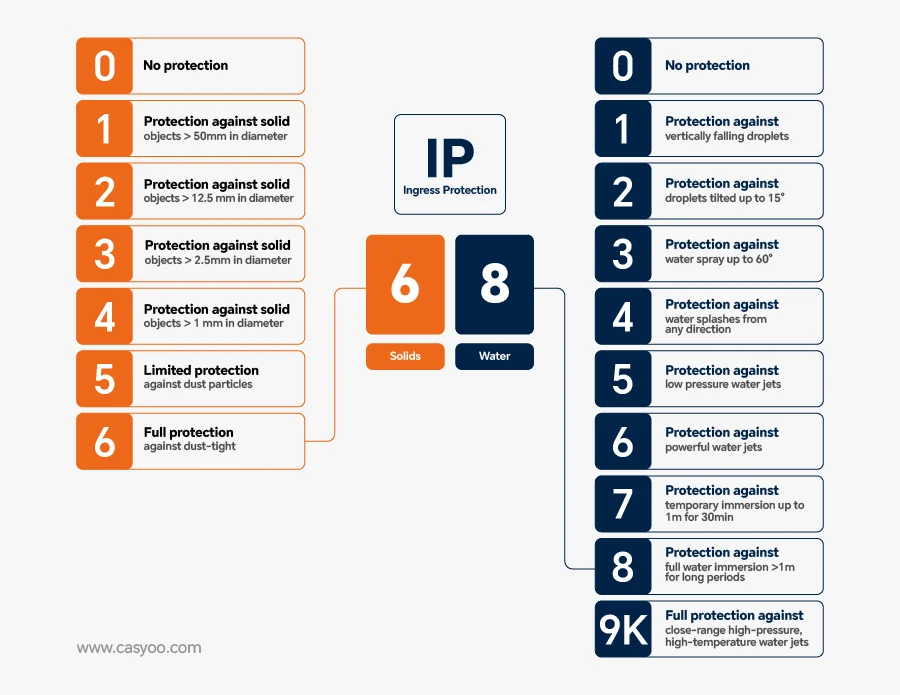
IP54 vs IP65 vs IP66 vs IP67 vs IP68: What’s the difference?
To make sure the LED fixture you buy is a great fit for your specific use, it’s essential to check the manufacturer’s product data sheets and specifications. Here’s what the most common ratings mean in practice for LED lighting:
IP54 — Basic protection. Dust Protected (limited ingress) that will not interfere with normal operation and will be protected against splashing water from any direction. Suitable for semi-outdoor fixtures, covered areas, or workshops with some airborne dust.
IP65 — Fully dust-tight and able to handle low-pressure water jets. It is the standard and one of the most common ratings for outdoor LED floodlights, facade lighting, garden lights, traffic signals and street lighting. These LEDs are subjected to rain exposure, but are not necessarily expected to be submerged.
IP66 — Dust-tight and withstands more powerful water jets than IP65. It is often selected for street lights, flood lights, rooftop fixtures, and other installations exposed to heavy rain or wind-driven water. In coastal areas, IP66 should also be combined with suitable corrosion-resistant materials and surface treatment.
IP67 — Fully dust-tight and protected against temporary immersion up to 1m. Common for in-ground uplights, low-level landscape lights, or fixtures in flood prone areas. However, note that IP67 does not mean the fixture has also passed IP65 or IP66 unless a combined rating is stated.
IP68 — Fully dust-tight and water-resistant against continuous immersion beyond 1m. Used for underwater fixtures, pool lighting, and fountain lighting.
Is IP68 fully waterproof or submersible?
IP68 does mean a fixture can withstand continuous immersion under conditions specified by the manufacturer. However, “fully waterproof” still needs some qualification. The product datasheet should specify the exact depth and duration the fixture was tested for, and these conditions can vary between fixtures. An IP68 light rated for immersion at 1.5 m for 24 hours, for example, is not necessarily suitable for permanent installation at a depth of 3 m.
It is also important to check the intended water environment. Standard IP68 testing does not necessarily cover chlorinated pool water, saltwater, chemically treated water, moving currents, or high-pressure water exposure. If your project involves any of these, refer to the specific guidance provided by the manufacturer rather than assuming the IP68 mark alone covers you.
Is a higher IP rating always better?
In general, yes: a higher second digit means the fixture is protected against more demanding water exposure. However, this does not mean that the highest availableLED IP rating is always the best choice for LED lighting.
Of course the first consideration is cost, as the higher the rating, the tighter the seals, the more precise the manufacturing, and the more rigorous the testing will be, all of which increase production cost. If you’re putting an IP68 light under a covered porch, you’re basically paying for extra immersion protection that the fixture will never need.
Heat also matters: a highly sealed housing can make heat more difficult to manage unless the fixture has an effective thermal design. Waterproofing should therefore be considered together with housing design and thermal management.
Certain high-IP fixtures adopt potting compounds or an even more permanent sealing technique that makes it hard to get to the internal components. Sometimes it is easier to replace a whole fixture if a component fails than to repair it.
It is better to choose IP rating that matches the actual use you are looking for, than to opt for the highest possible number.
Why IP rating matters for outdoor LED lighting
Outdoor LED fixtures are exposed to conditions that indoor fixtures never encounter: rain, humidity, dust, temperature swings, and in some cases, direct hosing or washdown. Choosing a fixture with an insufficient IP rating typically leads to moisture ingress, corrosion of internal components, LED driver failure, and a shortened fixture lifespan, often well before the rated service life of the LEDs themselves.
Beyond protecting the fixture, the right IP rating also protects your project: an underrated fixture failing prematurely can mean re-opening a facade, digging up buried cabling, or draining a pool to carry out repairs. In outdoor and industrial LED projects, the IP rating is rarely a detail worth cutting corners on.
How to choose the right IP rating for different lighting applications
So, aside from all the technical mumbo-jumbo, the only real question that matters is: What level of waterproofing do you really need? The right LED IP rating depends entirely on where and how the fixture will be installed:
Indoor, dry environments, such as offices and retail spaces: IP20 is generally sufficient.
Bathrooms, kitchens, and covered outdoor areas: IP44 is sufficient protection against splashing water, but if the area is more exposed, then you need to consider IP54 or IP65.
Fully exposed outdoor lighting, such as facades, car parks, street lights, and flood lights: IP65 or IP66 is commonly used, depending on the severity of rain and wind-driven water.
In-ground or flood-prone installations: IP67 provides protection against temporary immersion. For example, pathway lights installed in low-lying areas may sit in runoff after heavy rain.
Underwater, pool, or fountain lighting: IP68 is typically needed if the items are submerged continuously. Instead of assuming that all IP68 fixtures work the same, it’s best to verify the specific depth and duration rating of the manufacturer you have in mind.
Food-processing or industrial washdown environments: Look specifically for IP69K certification in addition to IP66 or IP68, since washdown resistance is a separate test from immersion resistance.
If in doubt about which environment your LED fixture will face, it’s worth over-specifying slightly rather than under-specifying, since the cost of a higher-rated fixture is almost always lower than the cost of a premature failure.
Common mistakes when choosing LED IP ratings
Assuming a higher number is always better. As explained earlier, IP69K is not merely a higher version of IP68. The two ratings cover different test conditions: IP68 concerns immersion, and IP69K concerns high-pressure, high-temperature washdown.
Ignoring the second digit’s real-world meaning. IP65 and IP68 may both be used outdoors, but they provide protection against very different types of water exposure.
Assuming “outdoor” means waterproof enough. Outdoor is not a rating of protection but a description of the product. Don’t take the word “outdoor” as a guarantee of the IP rating, always check the actual IP rating and installation environment.
Trusting the marketing claim instead of the datasheet. Always refer to the manufacturer’s technical data sheet for the tested depth, time, and conditions behind the IP rating, and not just the rating itself.
Underspecifying for cost saving. Choosing a lower IP rating than the installation environment demands may save money initially. However, it can lead to premature failure, higher maintenance costs, and more expensive replacement work.
Basically it all comes down to one thing: the rating is just one portion of the equation, not the whole answer.
Final thoughts
Fog on the lens, corrosion inside the housing, or a fixture failing earlier than expected are often signs that the LED IP rating didn’t match the environment. Start by looking at what the light will actually face such as dust, rain, water jets, temporary flooding, or continuous immersion, and then choose the rating accordingly.
Casyoo offers LED fixtures with precisely specified IP ratings for various lighting uses. If you are installing a street light, outdoor fixture or grow light, our team can provide you with the protection level you need based on your particular application. If you’re ever in doubt about the level of protection your LED light’s environment requires, just feel free to contact our experts.