If you have ever compared LED fixtures before, chances are you have come across the terms “lux” and “lumens”. And you’ve probably read a handful of product pages speaking about how lumens tell you everything you need to know about a light’s brightness, or how lux is the only number that really matters. That’s all well and good, but what exactly is the difference between lux and lumens and what do the two terms actually mean? Like most people, you may know it has something to do with brightness, distance and light fixtures but could you break down the difference? Being a lighting manufacturer, we thought it is worth clearing up the confusion. So, here’s our simple, easy-to-understand guide on lux vs. lumens.
What are lumens (lm)?
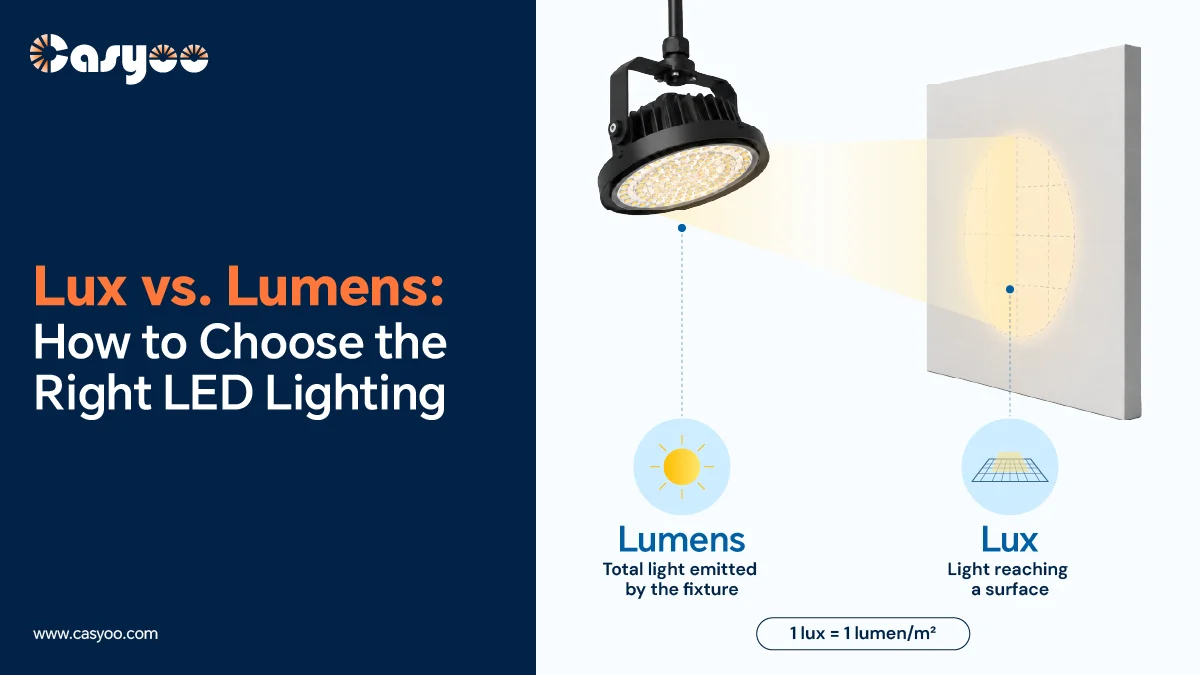
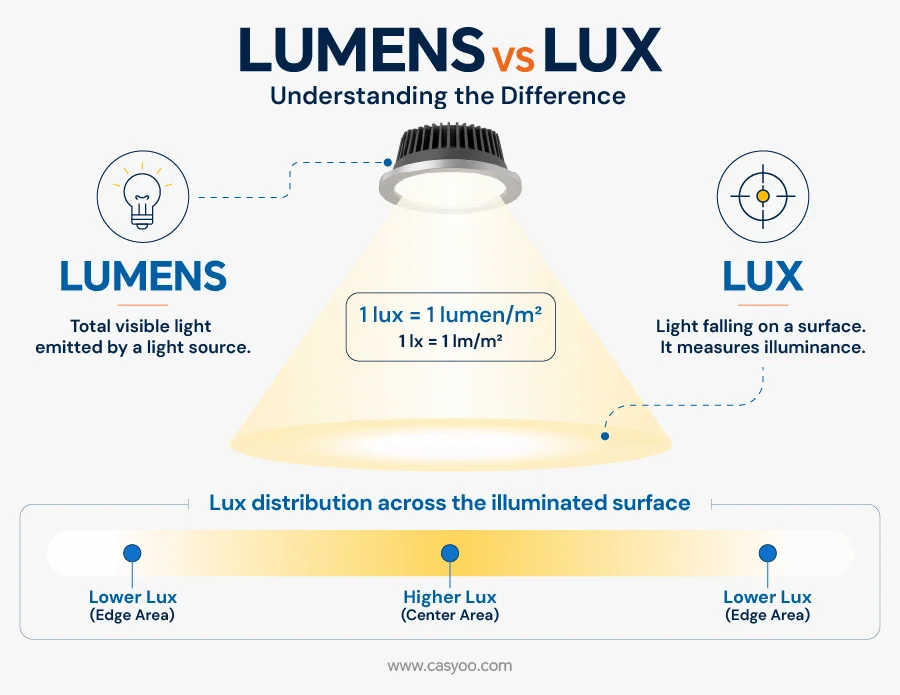
Lumens measure luminous flux, basically, the total amount of visible light a source emits in every direction. It’s a characteristic of the light source itself, full stop, regardless of where it is installed.
People often used to estimate brightness using wattage, a measure of electrical power used. Due to the rapid uptake of LED lighting, lumens became one of the major ways to compare the total visible light output of different products. A product’s rated lumen output does not change; it doesn’t matter how far away the light source is or which way the fixture is pointed, and the figure is typically printed on product packaging and datasheets.
Higher lumen ratings alone don’t automatically indicate better lighting performance. For example, a 12,000-lumen fixture seems to provide plenty of light, but with a narrow 60° beam, it can leave the areas beside it under-lit.
What is lux?
Lux measures illuminance — how much light actually falls on a given surface area. One lux = one lumen spread over a square meter (1 lx = 1 lm/m²). It is the metric used specifically in fields like workplace safety, architectural lighting design, and even horticulture.
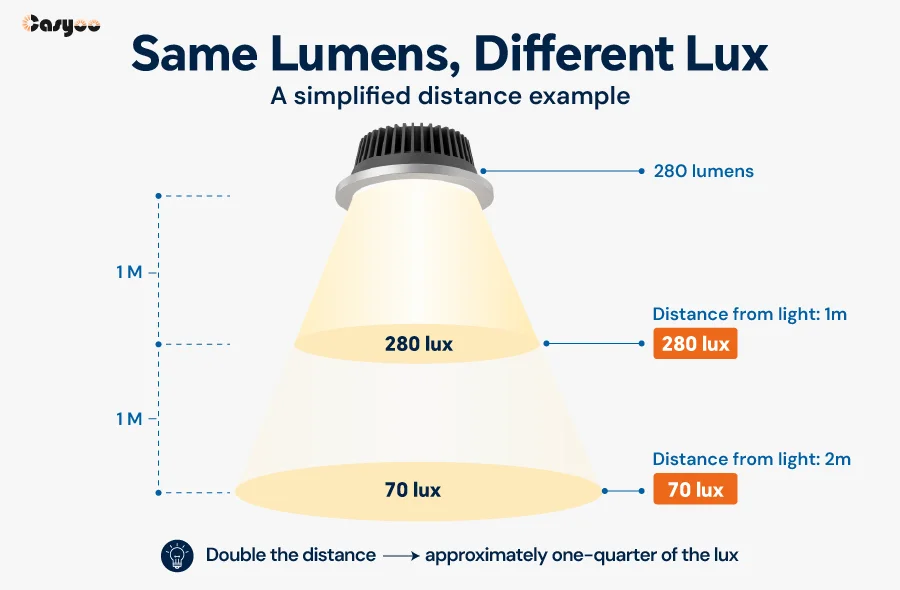
Lux roughly follows the photometric distance law: move twice as far away, illuminance drops to about a quarter. Beam angle, mounting height, and how reflective the walls are all factor in too. This fundamental difference means the same bulb can register very different lux readings in two different rooms.
Connecting lumens and lux usually requires photometric calculations, and we will dive into them below.
Lux vs lumens: key differences and relationship
The key difference in lux vs lumens is that lumens measure total light output, while lux measures the light reaching a surface. Both can be used in describing light, but from two different points of view for photometry.
Think of a garden hose. Lumens is the amount of water coming out of the hose, and lux is more like the amount of water that actually lands on and soaks a particular patch of ground.
The mathematical link between the two is:
Average lux ≈ lumens reaching the surface ÷ illuminated area (m²)
Doubling the distance of a light from the surface, the lux value drops to one-quarter of its original level, while the lumen remains unchanged. In practice, lumens are what you should check before making a purchase, and lux is what you check after installation to see if it is actually enough for its purpose. Professional lighting designers usually work backward from a target lux level to figure out lumen output and fixture spacing. Since light output degrades over time, a practical rule of thumb is to target 1.25 to 1.4 times the required lux level.
How are lumens and lux measured?
Lumens are measured once, at the source, typically inside a lab-grade integrating sphere, and the resulting number does not change regardless of where the bulb ends up installed. Measuring lux works differently. Lux is measured using a handheld or fixed lux meter, with an inside photodiode-based sensor calibrated to match the sensitivity of the human eye. The meter can be placed on a desk, a hallway floor or a plant-growing bench to measure the amount of light reaching that exact point. In all, lux isn’t really a fixed spec but rather a live reading that varies by location and method of measurement.
Special software, such as DIALux and Relux, is often used by lighting professionals to make a prediction of the lux levels throughout a floor plan before the project begins. Feed in the fixture’s lumen output, beam angle, and the room’s dimensions, and it generates a predicted lux map. After fitting, then a lux meter can be used to see if the reality matches the model. If finding somewhere falls short of its target, designers can adjust the fixture placement, spacing, or brightness.
Recommended lux levels for common applications
The ranges below are general reference ranges; project requirements need to be checked on the standard and measurement plane. Typical facilities used for offices, warehouses, hospitals, retail, and others make reference to relevant IES recommendations and EN 12464-1.
| Space/task | Recommended lux |
| Hallways, corridors, stairs | 50–100 lux |
| Living spaces | 100–300 lux |
| Library – reading/studying | 300–500 lux |
| General offices | 300–500 lux |
| Warehouses and industrial areas | 100–300 lux |
| Retail displays | 300–1,000 lux |
| Detailed inspection work | 750–1,000+ lux |
| Medical examination areas | 500–1,000 lux |
A lux reading is really just the end result of the fixture’s output, its beam spread, how high it’s mounted, and what the room around it reflects back.
Lux and lumens in street lighting
The lumen output difference from delivered illuminance is particularly easy to see in street lighting. Even if a fixture can produce enough total output of light, it may still have too wide a pole spacing or poor optics, resulting in dark bands being left between the poles.
Most municipal lighting standards specify minimum lux levels, typically between 5-30 lux at the road/sidewalk level, depending on the road and sidewalk. The volume of traffic lanes and classification of the road will determine the exact number. Often, pedestrian zones have their own targets as well, usually for safety reasons, and the crosswalks in particular. Engineers often model this out in advance, trying to avoid dark gaps between poles and not wasting light by overlapping too much.
Average illuminance alone is not enough; uniformity also matters. It makes sense since we cannot put a streetlight directly above every inch of road. That sort of unevenness variation, with bright light under the pole, dim in between, can actually be more dangerous for drivers than a dim road with even lighting. It’s because the human eyes take time to adjust between bright and dark areas. There is software designed to help hit that balance, and modern streetlight design cares more about achieving uniformity of lighting than cranking up the total lumen output of each fixture.
Lux, lumens, and PPFD in grow lighting
LED Grow lighting introduces a third measurement: PPFD, or Photosynthetic Photon Flux Density. It measures the amount of light received by plants within the range of light wavelengths used by plants for photosynthesis, in units of micromoles of photons per square meter per second.
Lux and lumens weigh light based on human visual sensitivity. On the other hand, PPFD counts photons across the photosynthetically active range, making it more relevant to crop lighting. A fixture, therefore, looks impressive in lumen or lux terms, but can deliver an unsuitable PPFD distribution across the canopy.
All Casyoo LED grow lights specify PPFD directly, as most professional-grade fixtures on the market do. Similar to lux, PPFD is measured at the plant canopy height. A quick and rough comparison of the spectra of white-light grow lights is still possible at Lux. For commercial projects, however, buyers should compare PPFD maps measured at the same hanging height and coverage area. If the edge of the canopy receives significantly less light, a high center reading isn’t very important.
How to choose LED lights using lux and lumens
Start with lumens to shortlist fixtures. Lumen rating is a simple comparison of the amount of raw light output of a product.
- Determine the target lux level. Use the table above as a decent starting point, but check the actual standard if one applies for the task and environment for your project.
- Estimate lumens needed: target lux × room area (m²) (as detailed above). The actual fixture output will generally have to be higher than this as not all emitted light will reach the working surface.
- Factor in beam angle and mounting height. A wide beam or a high ceiling spreads the same lumens more thinly, so illuminance at the work surface drops.
- Plan for overlap, not gaps. Fixtures placed too far apart will leave gaps even if they have a high lumen rating; there is some overlap to prevent dim patches.
- Use photometric modeling when precision matters. For offices, warehouses, medical facilities, and other spaces with defined lighting requirements, use photometric modeling software or consult a lighting consultant to predict lux before installation. Once installed, check using a lux meter and adjust fixture position or output as needed.
If you’re mid-project and want a second opinion on fixture selection or lux targets, that’s the kind of thing we help customers work through every day. You can also use our Lumen & Watt Calculator for accurate LED lighting calculations!
Frequently asked questions about lux and lumens
What is the difference between lux and foot-candles?
Lux and foot-candles are both used to measure illuminance. The difference is that foot-candles measure lumens per square foot, while lux measures lumens per square meter. Lux is part of the metric system and is widely used around the world. Foot-candles are still commonly used in some lighting standards in the United States.
How many lux is 1,000 lumens?
It can vary by the amount of light that falls on the illuminated area, and the amount of light that actually reaches it. Then, 1,000 lumens are distributed evenly over 10 m², resulting in an average illuminance of around 100 lux.
Continue to reading about lumens vs lux