Most street lights stay on all night to ensure the safety of the residents. In some countries, the government will dim the light in the midnight when there are few cars or pedestrians. If you wake up early one day, you may witness street lights close around sunrise. Then how do street lights work to turn on or off automatically? Read the following passage about the control system and electrical features of street lights to get the answer!
Core components of street lights
A street light is normally comprised of a light, pole, control unit, electric unit, and communication module.
- Light source: Conventional streetlight sources are high-pressure sodium lamps or metal halide lamps, but nowadays LED technology has emerged as the prevalent option in lighting today. Such primary element not only decides brightness but also energy efficacy and the quality of the light.
- Electric components: Hidden circuits, connectors, and power controls are found around luminaires. Relays hold high currents, and the employment of dimmers enables power reduction in low-traffic applications. Smart street lighting networks consolidate such components with controllers, from simple local streetlight controllers (SLC), which regulate single fixtures, to centralized data concentrator units (DCU), synchronizing an entire area.
- Control system: Light-dependent resistors (LDRs) or photocells are the eyes of the system and detect the dusk and the dawn to start working automatically. Other premium devices include motion sensors that detect the movement of individuals or vehicles and dynamically adjust brightness.
- Communication module: It carries working data from the intelligent street lamps to the central monitoring station through the wireless communication protocols.
- Pole for light: Typical pole materials include steel and aluminum alloy that are employed to provide strength and corrosion protection.
How are street lights controlled?
Street lights can have the following five control methods:
- Timing control: LED street lights can turn on and off automatically through a preset schedule. Timing control usually requires timers or a centralized control system.
- Remote control: Remote control devices such as mobile phone application-based controllers can switch the street lights on or off at a distance.
- Light control sensor: Light control sensors can sense the surrounding ambient light intensity, thereby automatically controlling the switch.
- Motion Sensors: Modern smart street lights may use either microwave radar sensors or passive infrared sensors (PIR) to measure movement, so that it can activate lights on demand. Radar sensors detect movement through the transmission of high-frequency electromagnetic waves and the interpretation of the reflected waves of moving objects. Infrared sensors, however, measure the alteration of the infrared radiation field by moving bodies.
- Network control: Some advanced LED street lights can connect to the network to achieve centralized management and monitoring.
Usually, street lights around us work with two of the above control methods: light control sensing and timing control. The light control sensor adjusts LED street light brightness in response to surrounding light intensity, effectively saving energy. The cylindrical component on top of the street lamp shade is likely the light control sensor. This design enhances the sensor’s ability to receive light signals.
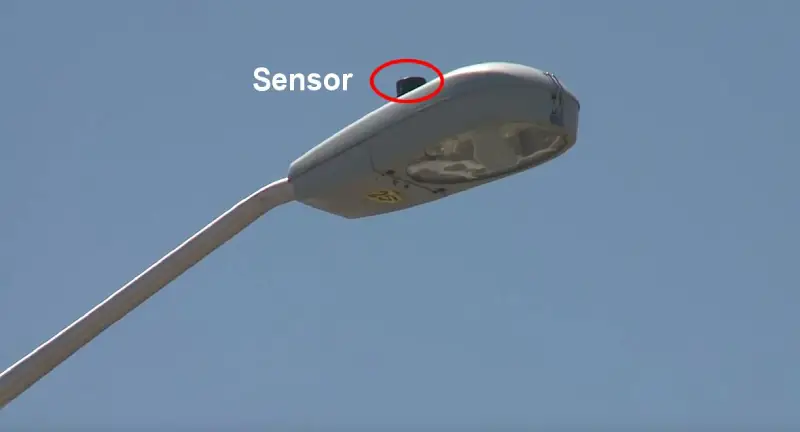
Timing control follows preset schedules for switching street lights on and off accurately within specific time periods. However, sensor control offers greater flexibility and intelligence. Many street lights still use timing control because the sensing technology will increase costs and is hard to implement in old street light systems. Besides, some areas need to turn on the lights within a specific time period, so they keep the timing control system. In the future, light-controlled sensors will become increasingly popular.
What voltage do street lights use?
In the United States and Canada, the standard voltage for street lights is typically 120V, whereas in most parts of Europe, it ranges from 220V to 240V. Public grid-provided AC power is commonly used for street lights, with voltage regulators to achieve the appropriate range. You can find street lights that can work in these voltage in Casyoo!
In off-grid areas and in urban development projects that focus on sustainability, some street lights use solar energy. Photovoltaic panels convert sunlight to power throughout the day, charging banks of batteries through a controller. At night, the batteries power the unit of LED lighting continuously, and intelligent controllers adjust brightness dynamically accordingly.
How many amps do street lights use?
The current of street lights is generally between 0.1 amp (100 mA) and 1 amp, depending on the power and type of the light source. Compared with household appliances, street lights generally have smaller power and higher voltage, so the current is smaller than that of household appliances.
Are street lights wired in series or parallel?
These lights are typically wired in parallel. In this way, it ensures that each LED street light receives the same voltage and that the failure of one light does not affect others. The LED street light circuit includes power input, voltage regulator, drive circuit, light source, controller and sensor, heat dissipation device, etc.
Smart street light systems: How do street lights work in modern cities
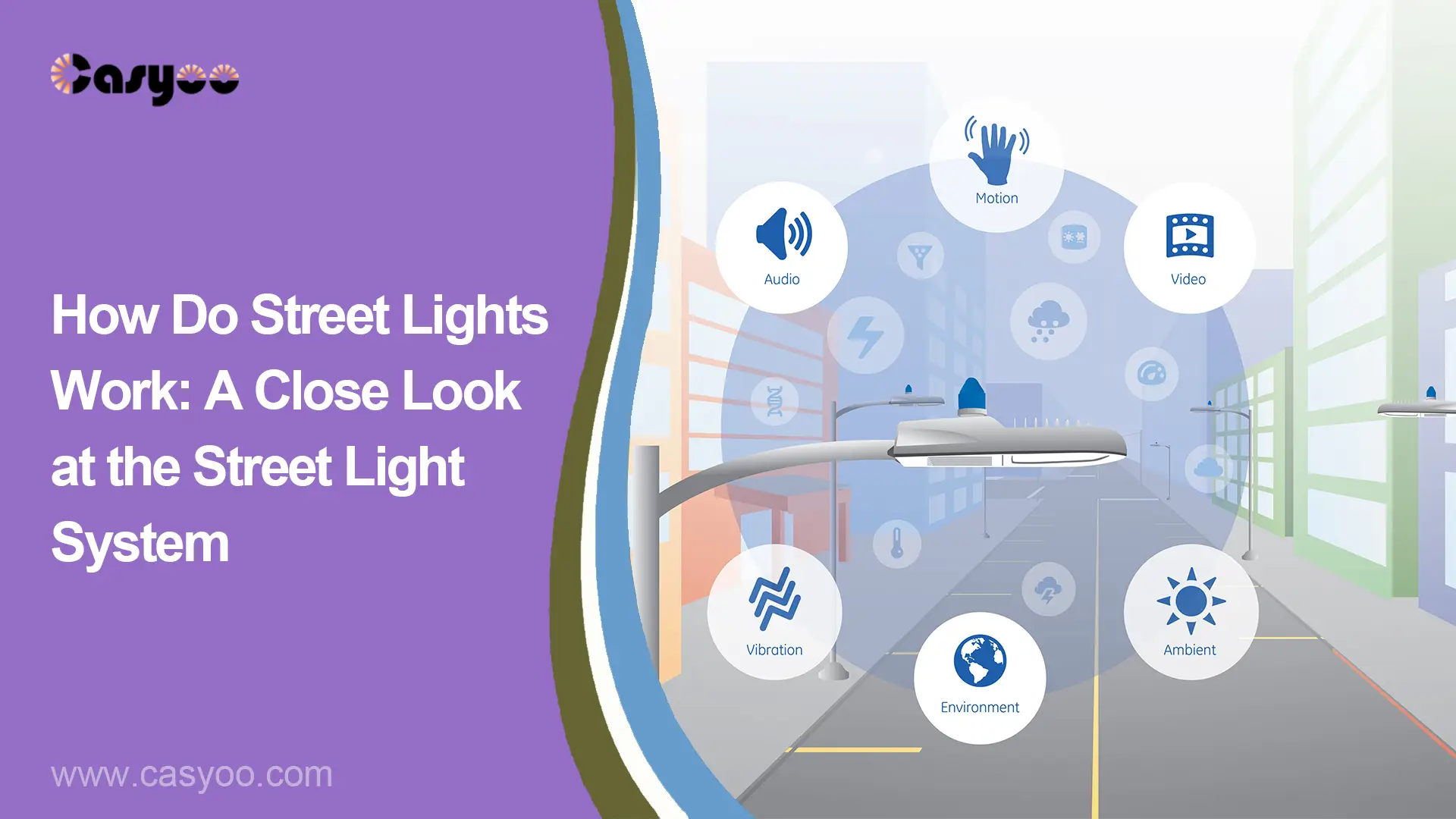
With the advancement of IoT technologies, smart street light systems have already been piloted in many cities. The communication process of smart streetlights generally involves three stages: from sensors to the communication layer, and then to the control console. Sensors in the streetlight can capture information such as ambient brightness and vehicle movement. Such sensor inputs go through the communication layer, where wireless communication protocols such as Wi-Fi, Bluetooth, Zigbee, or LoRaWAN set up mesh networks between luminaires. Everything is finally centralized at the central platform, where operators are capable of undertaking remote scheduling, consumption monitoring, and fault detection.
These systems are also becoming a physical foundation of larger smart cities. Lamp poles are also used today as Wi-Fi hotspots, air quality stations and electric vehicle charging stations. In cities like Singapore and Barcelona, connected streetlights provide the network for municipal IoT devices, enabling monitoring of everything from parking space availability to the fill levels of waste bins.
Conclusions
In this passage, we have explained the internal and external systems of street lights, focusing on the control system. Sensors or timers allow street lights to turn on and off automatically. They use the utility grid, typically using 120 volts in America and 220 to 240 volts in Europe, with a current ranging from 0.1 to 1 amp. Street lights work in parallel, and the wiring process may involve cable laying, circuit connection, and joint debugging. We hope that this passage helps you have a comprehensive understanding of the street light system!