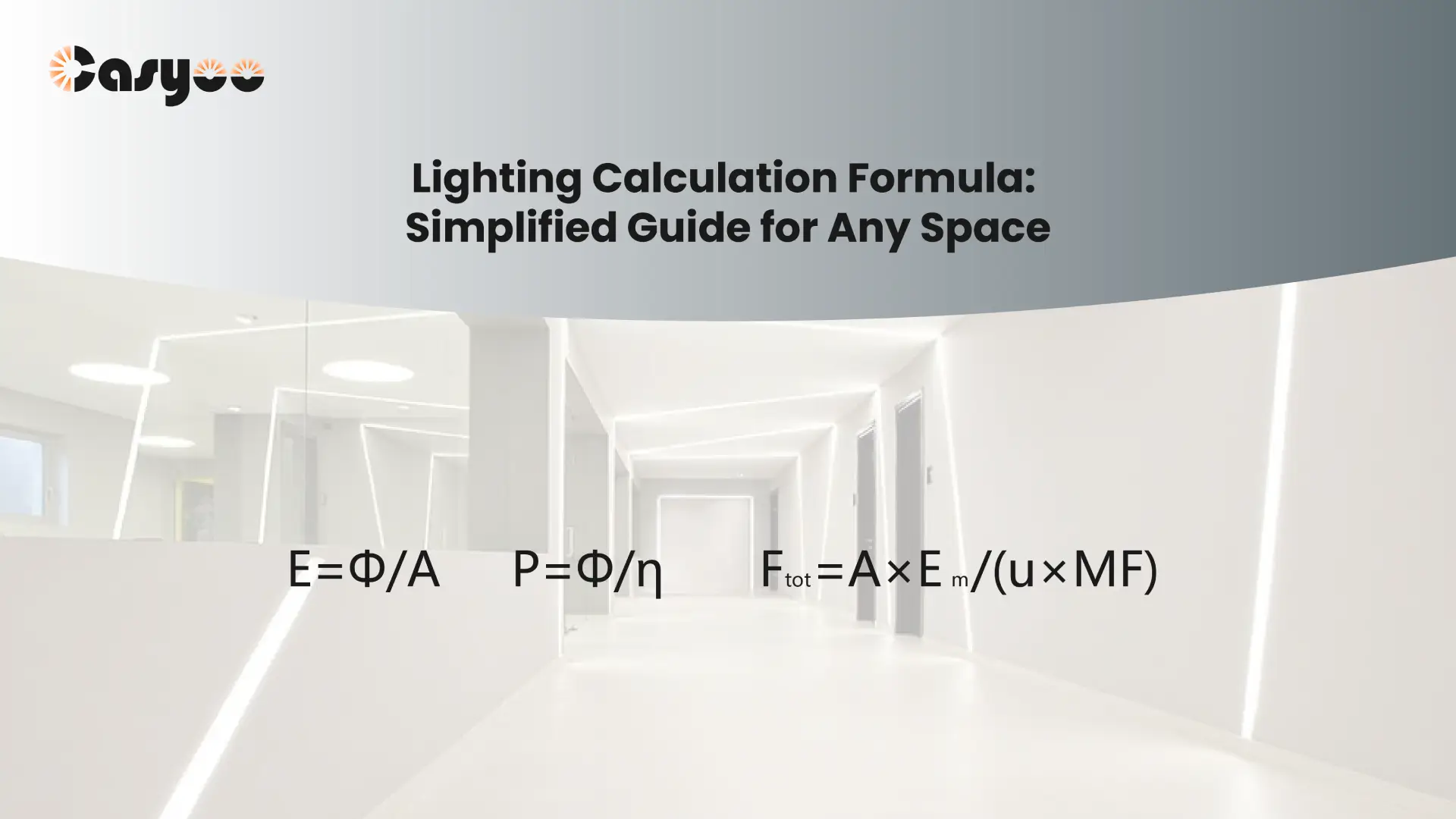
Ever wondered how much light your home, office, or commercial space really needs? Whether you are setting up cozy living spaces or designing lighting for large industrial projects, the knowledge of lighting calculation formula is indispensable. This article will walk through the math and simplify the concept into actionable steps for any person—be it a curious homeowner or a seasoned engineer.
The goal? Equipping you with the knowledge to make informed lighting choices for better energy efficiency and improved visual appeal in your spaces. Ready to bring your lighting design to life? You can try our free tool first to calculate the key lighting parameters: lumen and watt. In this passage, we also provide other useful formulas. Read on!
Understanding the Basics: Lumens, Lux, and More
At its core, lighting calculation is about understanding how light behaves. You’ll need to know a few key terms:
- Lumen (lm) measures the total light output of a fixture. Think of it as the “volume” of light.
- Lux (lx) is the amount of light that hits a specific surface, lumens per square meter. Imagine sunshine on a table-how bright does it get?
- Candela (cd) is a unit of light intensity in a given direction, like the beam of a flashlight.
- Foot-candles (primarily used in U.S.) are lux’s imperial equivalent, expressing lumens per square foot.
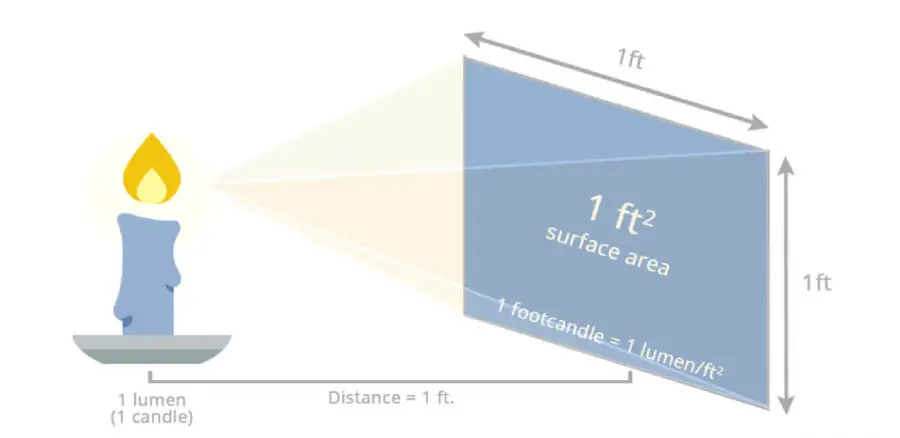
Lux and Lumens: Calculating illuminance
To find illuminance (amount of light that falls on surface):
E=Φ/A
Where E is illuminance (lux), Φ is luminous flux (lumens), and A is the area (m²).
This formula helps determine how much light covers a specific area, essential for designing effective lighting solutions.
Imagine a 4000-lumen LED in a 20 m² (215 sq.ft.) room. With the formula :
Lux=4000/20=200lux
That’s plenty for ambient light. Need it brighter? Then use a second light or narrow the beam.
Calculating Total Lighting Requirements
How Much Light Does Your Room Need?
It is necessary to determine proper light levels for a room or space with regards to functionality and comfort. Illuminance, which is measured in foot candles or lux, varies in what a given space is put to use for.
- Residential Spaces:
- Living Rooms: The goal is 10–20 fc (100–200 lx), a warm and soft, general atmosphere suitable for rest.
- Kitchens: Need 30–50 fc (300–500 lx) to produce enough brightness for tasks such as cooking and food preparation.
- Bedrooms: 15–30 fc (150–300 lx) is optimum for general activities with higher levels near reading areas.
- Bathrooms: 20–50 fc (200–500 lx) to allow grooming tasks to be seen clearly.
- Commercial Spaces:
- Offices: General work areas require 30–50 fc (300–500 lx) to aid productivity, but tasks requiring detail may require as much as 100 fc (1000 lx).
- Retail Stores: Sales floors benefit from 50–100 fc (500–1000 lx) to enhance product visibility and appeal.
- Warehouses: General storage areas require 10–30 fc (100–300 lx), and areas for packing and shipping 30–50 fc (300–500 lx).
- Parking Lots: 5–10 fc (50–100 lx) for safety and security.
- Sidewalks and Walkways: 5–15 fc (50–150 lx) for safe pedestrian passage.
- Building Entrances: 20–50 fc (200–500 lx) for good visibility and improved security.
These are guidelines only. Lighting needs may actually be quite different depending on specific tasks, user preferences, and local regulations. Consultation with a lighting professional will help to tailor the solutions for each space’s unique needs.
Real-World Applications of Lighting Calculation Formula
Example 1: Brightening a Kitchen
For cooking tasks, a 10×10 ft (about 9.3 m²) kitchen would require about 430 lux of effective lighting. To determine the total lumens needed:
430 lux * 9.3 m² = 3,999 lumens
To get this with modern LED lighting at 100 lumens per watt, you would want:
3,999 lumens / 100 lm/W ≈ 40 W
That would be dispersable with 4 LED fixtures, each being 10W, providing efficient and concentrated task lighting.
Example 2: Reading in a Study
For tasks requiring concentration, such as reading, sufficient lighting is required so that one will not strain their eyes. The prescribed illuminance value for a study or reading location is approximately 300 lux. To achieve this in a room with dimensions of 50 square feet (about 4.65 square meters), you would need:
300 lux × 4.65 m² = 1,395 lumens
With the efficiency of modern LED lighting, often well over 100 lumens per watt, a 14-watt LED bulb would be more than ample to read comfortably.
Lighting Calculation Formula of Power and Energy Efficiency
To calculate the wattage required:
P=Φ/η
Where P is power in watts, Φ is lumens and η is luminous efficacy in lm/W. For 5000 lumens at 100 lm/W:
P=5000/100=50W
Energy Consumption and Sustainability Calculations
Lighting Power Density (LPD)
Lighting Power Density (LPD) is a key mandatory indicator for evaluating the energy efficiency of a lighting system. It is defined as:
LPD = Ptotal / A
In which Ptotal is the sum of all lighting system installed power (in watts, W), and A is the area of the room (in square meters, m²). The unit of LPD is W/m². National standards (such as China’s Code for Lighting Design of Buildings GB 50034) stipulate maximum permissible values, and in some cases target values, for LPD in different types of buildings and spaces.
Through precise lighting calculations, you can ensure compliance with illuminance requirements while selecting efficient light sources and luminaires (i.e., with high lm/W). This assists in the optimization of the number of fixtures (N) and overall power (Ptotal) so that the actual LPD of the final design is under the regulatory limit.
Annual Energy Consumption (AEC) Calculation
Whereas LPD is a fixed power indicator, annual energy consumption (AEC) is an indication of the actual consumption during the entire year.
The core calculation formula is:
AEC = Ptotal * t * K
where:
Ptotal: total installed power of the lighting system (kW)
t: annual operating time (hours per year, h/yr)
K: utilization/maintenance factor adjustment (typically ≤1), used to account for the fact that not all lights are switched on simultaneously, as well as the savings achieved through intelligent controls such as sensors or dimming.
Advanced Lighting Calculation Formula for Professionals
Large areas, such as offices or warehouses:
Ftot=A×Em/(u×MF)
Where:
- Ftot: Total luminous flux needed
- Em: Mean illuminance required
- u: Utilization factor
- MF: Maintenance factor
Example: 500 m² factory with 300 lux needs:
Ftot=500×300/(0.8×0.9)≈208,333 lm
You would want about 40 high-bay LED fixtures with 5000 lumens each.
Lighting Calculation Consideration: Layout and Spacing
Proper spacing enhances both functionality and aesthetics. As a general rule, space fixtures 1.5 times the mounting height. For 8 ft ceilings, lights are spaced about 12 ft apart.
Reflective surfaces, dark walls, and high ceilings require adjustments. For instance, rooms with dark paint absorb light, so you’ll need 10–20% more lumens.
Modern Trends in Lighting Design and Calculation
Lighting design is evolving toward adaptability and people-oriented solutions. To create a relaxing atmosphere, achieve warm tones in the range of 2700–3000K with illuminance at 150 lux in living spaces; for productivity-focused environments, cool tones in the range of 4000–5000K coupled with calculations of 500–750 lux, depending on the task, are recommended. In a lighting system, smart LEDs can be used to dynamically change their output in a manner that can simulate natural daylighting patterns, while exact lighting calculations ensure these systems provide optimal illumination levels for both comfort and efficiency.
Smart technology, combined with LED lighting, is transforming home and commercial spaces. You can sense the demand for lighting dynamically by using motion sensors and dimmers to calculate real-time usage. For example, smart systems can measure actual occupancy levels and then calibrate their output accordingly to maintain pre-set lux levels in each room.
Light Up Your Room with Confidence
Lighting calculation is the key to creating well-designed, energy-efficient spaces tailored to your needs. Mastering concepts like lumens, lux, and effective layouts will transform any environment—be it your house, office, or outdoor space—into a perfectly illuminated one. LED technology takes this a step further, offering unmatched efficiency and versatility.
Lighting calculation doesn’t need to be complicated, and we make it easier. Our high-performance LED products mean you get unbeatable efficiency, long-lasting durability, and tailor-made solutions for any setting. What’s more, our team is ready to assist with precise lighting calculations to ensure your space is illuminated perfectly—no guesswork involved.