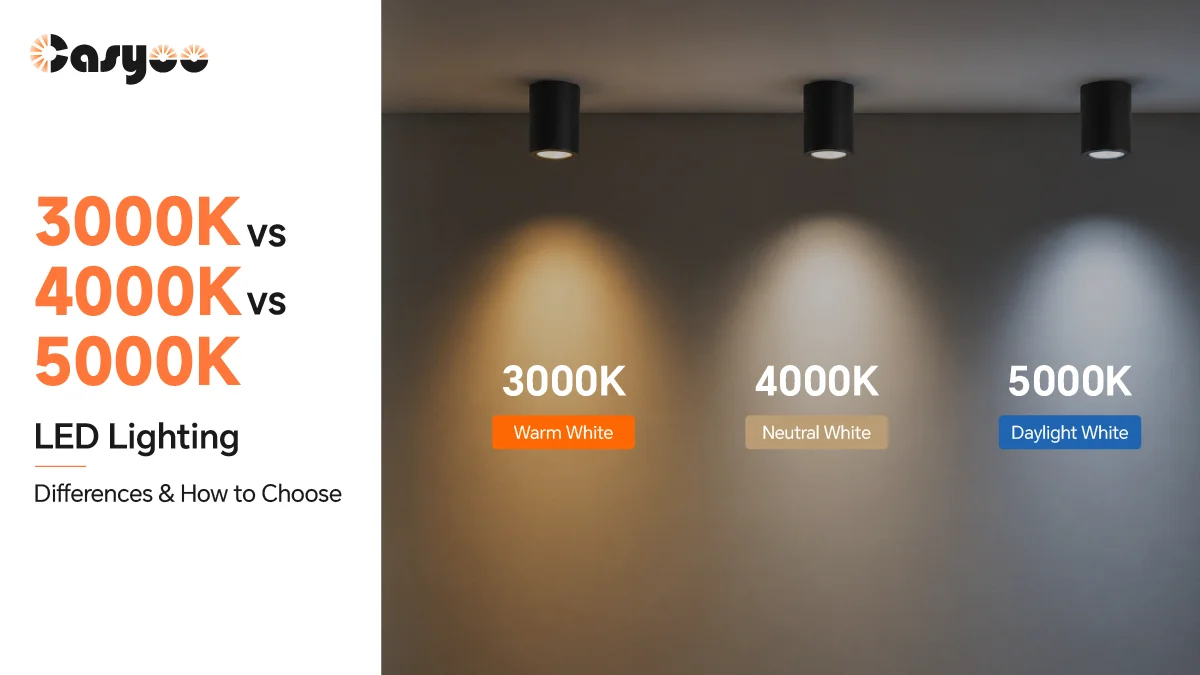
Whether you’re lighting a home, office, warehouse, or retail space, choosing the right color temperature has a major impact on how the space looks, feels, and performs. Among key LED lighting specifications, including lumens, CRI, beam angle, and wattage, correlated color temperature (CCT) has the most direct impact on how a space looks and feels. The three most common color temperature options—3000K, 4000K, and 5000K—each produce a distinct lighting effect and are suitable for different residential, commercial, and industrial applications.
This article explores 3000K vs 4000K vs 5000K LED lighting, discussing their characteristics, applications and the science behind their differences. It provides a comparative analysis of these color temperatures, focusing on visual comfort, task performance and circadian impact, to aid in selecting the most suitable option for your lighting project.
A comparison between 3000K, 4000K and 5000K
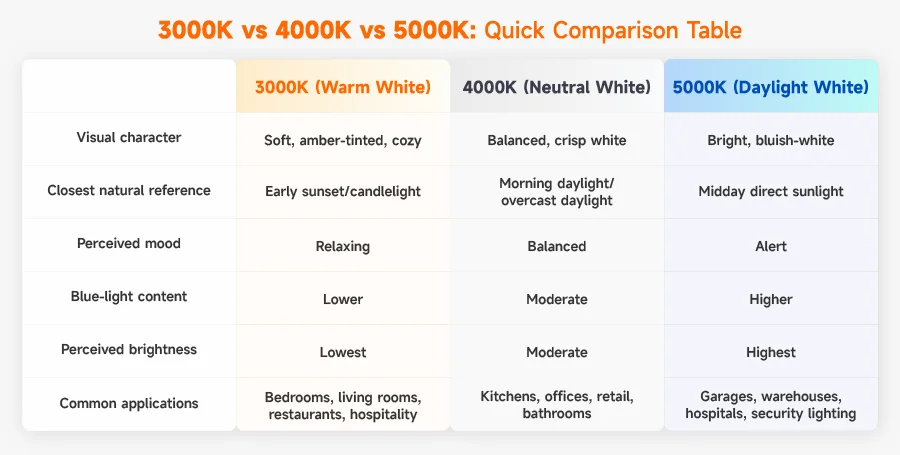
Let’s start with a high-level look at how 3000K vs 4000K vs 5000K stack up against one another. The following table offers a helpful summary in determining which color temperature might best suit your application and product design needs.
What is color temperature and why it matters
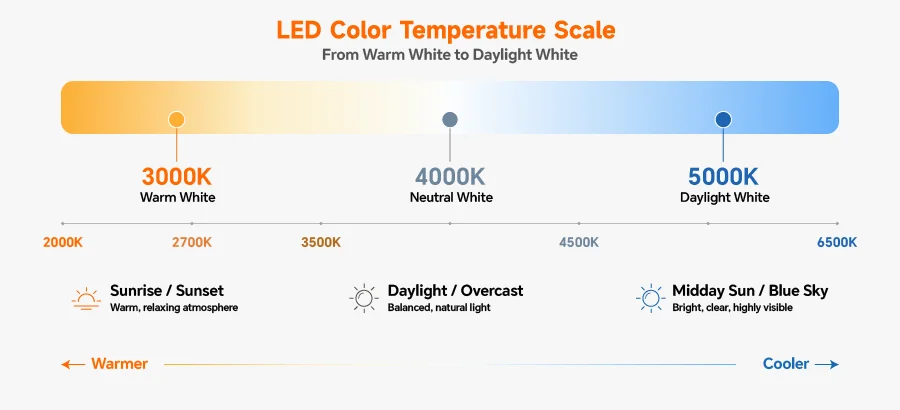
The concept of color temperature traces back to blackbody radiation theory. Color temperature refers to the color of light emitted by a theoretical blackbody radiator as it is heated, transitioning gradually from deep red to orange-yellow, white, and finally to blue. A light source’s color temperature, measured in Kelvin (K), is the temperature at which the color of the light source matches the color of a black body. It describes the perceived “warmth” (reddish color at low values) or “coolness” (bluish color at high values) of a light source rather than its actual operating temperature. A lower Kelvin value (like 2700K–3000K) would yield a warm, yellowish glow light, and higher values, in the case of 5000K–6500K, emit a cooler, bluish-white light. In lighting engineering, this concept is more precisely described as correlated color temperature (CCT).
“The absolute temperature of a blackbody whose chromaticity most nearly resembles that of the light source.”
This is one of the many measurements used when designing, engineering, or selecting lighting for a certain space or room, as it allows you to set up the light conditions that you would prefer to have in that space.
Understanding 3000K
The 3000K color temperature is known as warm white and is one of the more popular color temperatures used in the hospitality, architecture and landscape lighting applications. It emits a soft, slightly yellowish glow that can help create a relaxed and inviting ambiance, making it suitable for areas where warmth and comfort are essential.
Modern white LEDs achieve 3000K using a blue LED chip with a specially formulated phosphor layer that converts some of the blue light into a warm amber-colored white light. 3000K has less blue light than 4000K and 5000K, creating a softer and warmer visual effect that is typically considered to be more pleasant and comfortable, even in low light or at night.
In places where you need maximum visibility, or complete accuracy, like inspection areas, factories or warehouses, 3000K is not recommended.

Understanding 4000K
For commercial interiors, 4000K is a common choice that provides a balanced appearance that isn’t too warm or cool. It is praised as the de facto neutral standard. It delivers sufficient amounts of blue-light content to give a feeling of cleanliness and energy without being too harsh or clinical. As a safe neutral choice, 4000K pairs beautifully with both warm and cool interior design schemes and is commonly used for commercial offices, public walkways, mid-bay warehouses and LED street lighting applications where it is important to have clear and professional clarity.
Understanding 5000K
In situations where visibility and detail are paramount, 5000K is one of the most popular options, introducing a high-output visual layer that leans on strong blue wavelengths. It approximates the crisp, distinctive hue of direct midday sunlight. Among the three CCT options, 5000K has the highest perceived brightness and contrast.
The higher blue-light content improves perceived contrast, which makes details clearer when performing tasks and in large spaces. Therefore, 5000K is sometimes positioned as a more alert-inducing, high-contrast lighting technique than 3000K and 4000K.

Choosing between 3000K, 4000K and 5000K
The selection of color temperature depends on the application, desired atmosphere, and level of visibility desired. 3000K, 4000K, and 5000K each have their own strengths, but no single option is perfect for every environment. For many lighting projects, various color temperatures are even combined to balance comfort and functionality. Let’s take a closer look at how key performance factors compare across the three CCT options.
Perceived brightness
Perceived brightness is a somewhat tricky metric to quantify, as there are many factors involved that can impact how bright a space feels. Although lumen output, fixture location, and surface reflectivity are all critical, the CCT of a light source is also directly related to perceived brightness particularly in the interior environment, where the reflectivity of the walls and ceilings influences the amount of light reflected. Furthermore, some spaces, like retail showrooms, have a specific need to use higher CCTs so that the product will appear brighter and more vivid under the same lumen output, which will improve perceived contrast.
At the same lumen output, 5000K light is generally perceived as brighter than 4000K, and 4000K is generally perceived as brighter than 3000K, in typical indoor applications. Because of this, it’s generally necessary to increase the lumen output to achieve the same perceived brightness at 3000K.
4000K shows a moderate improvement in perceived contrast and clarity, 5000K brings a further increase in perceived brightness and alertness, but there is always a tradeoff between visual comfort and stimulation. The visual “edge” of 5000K can sometimes be too intense in residential settings. Therefore, 5000K is recommended for task-critical or transient areas where brightness and clarity are the main concerns. This is more noticeable and can feel uncomfortable, especially in the evening, in more relaxed, extended-occupancy environments.
Psychological and circadian effects
- Emotional and behavioral influence
Natural daylight has a higher color temperature and stimulates the human brain, while light at dusk has a lower color temperature and induces relaxation and less stimulation. Therefore, high color temperature blue light serves well as task lighting, boosting work efficiency. On the other hand, warm light with a low color temperature at night, may help to relax and prepare the body to sleep.
- Blue light and circadian rhythm
First identified in the late 1990s, melanopsin-containing photoreceptors in the human retina were later found to be sensitive to blue light. Blue light (459–485 nm) has been associated with the inhibition of melatonin production and sleep disruption. As lower color temperatures produce lower levels of blue light emission, the use of lower color temperatures at night may help to promote healthy circadian rhythms.
Luminous efficiency
LEDs with higher color temperatures (e.g. 5000K) are more efficient than LEDs with lower color temperatures (e.g. 3000K). Usually, LEDs generate white light by means of a blue chip. Blue light is partially transformed into longer wavelengths (green, yellow and red) with a phosphor or wavelength converter to achieve different color temperatures. This conversion process is inefficient by itself: the greater the shift toward longer wavelengths, the more energy is lost. In order to get a warm color temperature of 3000K, more of the blue light needs to be shifted to longer wavelengths and therefore more energy will be lost. But higher color temperature, such as 5000K, means less conversion, mostly converting blue light into green light and the loss of energy is not so great. This is what makes 5000K lighting generally more efficient in terms of luminous efficiency than 3000K lighting.
However, in general the luminous efficacy of the 5000K LED is slightly higher than that of the 3000K LED, but generally not enough to make a difference in choosing a color temperature.
Best uses for 3000K, 4000K, and 5000K lighting
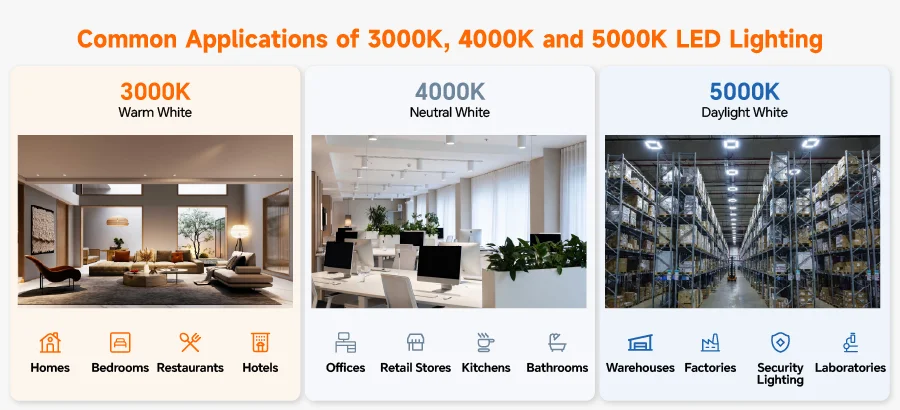
What are the ideal situations for diverse color temperatures? Based on more than ten years of industry experience, we have summarized the ideal applications for each of the three color temperatures.
3000K (Warm White):
- Living rooms and bedrooms
- Restaurants and hospitality spaces
- Hotel lobbies
- Spa and wellness environments
- Accent and ambient lighting
This color temperature can also be paired with dimmers, supporting adjustable, mood-based lighting scenes. Because of its warm tone it is a great option for spaces where guests or residents gather to relax, as it mimics the comfort of candlelight or fireplace glow. Also, it can help minimize eye strain in the evening hours.
4000K (Neutral White):
- Kitchens and bathrooms
- Offices and conference rooms
- Retail stores
- Garages and workshops
4000K is great for everyday functional lighting, particularly when a single space serves multiple purposes throughout the day.
5000K (Daylight):
- Warehouses and industrial facilities
- Security and outdoor lighting
- Hospitals and laboratories
- Detail-oriented workspaces
Top tasks that benefit from a 5000K light source are those that demand precision and alertness, particularly those that require detailed inspection or safety-critical activities.
Which color temperature should you choose
The best color temperature for your space will ultimately come down to your preferences, comfort, functionality, budget, current fixtures and the flexibility you need with future changes. Use this quick guide to help narrow down your decision:
- Want comfort and mood first? → Ideal for bedrooms, living rooms, restaurants and any place your guests or residents spend time relaxing.
- Need a balanced color temperature for use throughout the day? → Ideal for kitchens, offices and retail spaces that serve multiple activities throughout the day.
- Need the maximum contrast and alertness for task-critical or safety work? → Ideal for warehouses, laboratories, security lighting and thorough inspection tasks.
- Is the space used for different activities throughout the day? → Rather than picking a single CCT for the whole space, consider zoning (different CCTs in different areas) or CCT-selectable fixtures that let you adjust on-site.
The right CCT 3000K vs 4000K vs 5000K isn’t just a matter of aesthetics – it can detract from the space’s function – task lighting that’s too warm to work under, or hospitality lighting that’s too cool to be welcoming. In general, a 4000K color temperature works best in most commercial applications, a 3000K color temperature works best in comfort-oriented spaces, and a 5000K color temperature works best for high-visibility tasks.
Looking for an OEM/ODM lighting partner?
Selecting the right correlated color temperature is just half the job in specifying. The fixture design, beam distribution, lumen output and installation environment all have an impact on the desired lighting performance. The color temperature of Casyoo LED lights is optimal for a range of uses. At Casyoo, we collaborate with contractors, distributors and project teams to create solutions for fixed-CCT LEDs and selectable-CCT LEDs for a variety of commercial and infrastructure applications. For new projects or a lighting comparison, our engineering team can suggest lighting products and create photometric simulations according to your specific needs. Contact us today!
Frequently Asked Questions
Is 4000K too bright for a living room?
Not necessarily. 4000K isn’t brighter than 3000K at the same lumen output; its cooler white appearance often makes it feel brighter. For most living rooms, 3000K is preferred because it creates a warmer, more relaxing atmosphere.
Is 4000K harmful for eyes?
As a moderate color temperature, 4000K is well-suited for general lighting. While it does contain some blue light, it is not harmful to the eyes in everyday use.
Is 3000K too yellow or is 4000K too cool?
It depends. As mentioned earlier, different color temperatures suit different settings. In the office, 3000K might be too yellow, but in the bedroom, 4000K might be too cool.
Is 5000K brighter than 3000K?
At the same lumen output, 5000K is not physically brighter than 3000K, but it is generally perceived as brighter because it contains more blue light and creates higher visual contrast.
Will color temperature affect CRI?
Color temperature and color rendering are independent of each other, but they will affect visual comfort separately. Whether color temperature or CRI, if not appropriate, it will lead to eye fatigue.
Related reading: