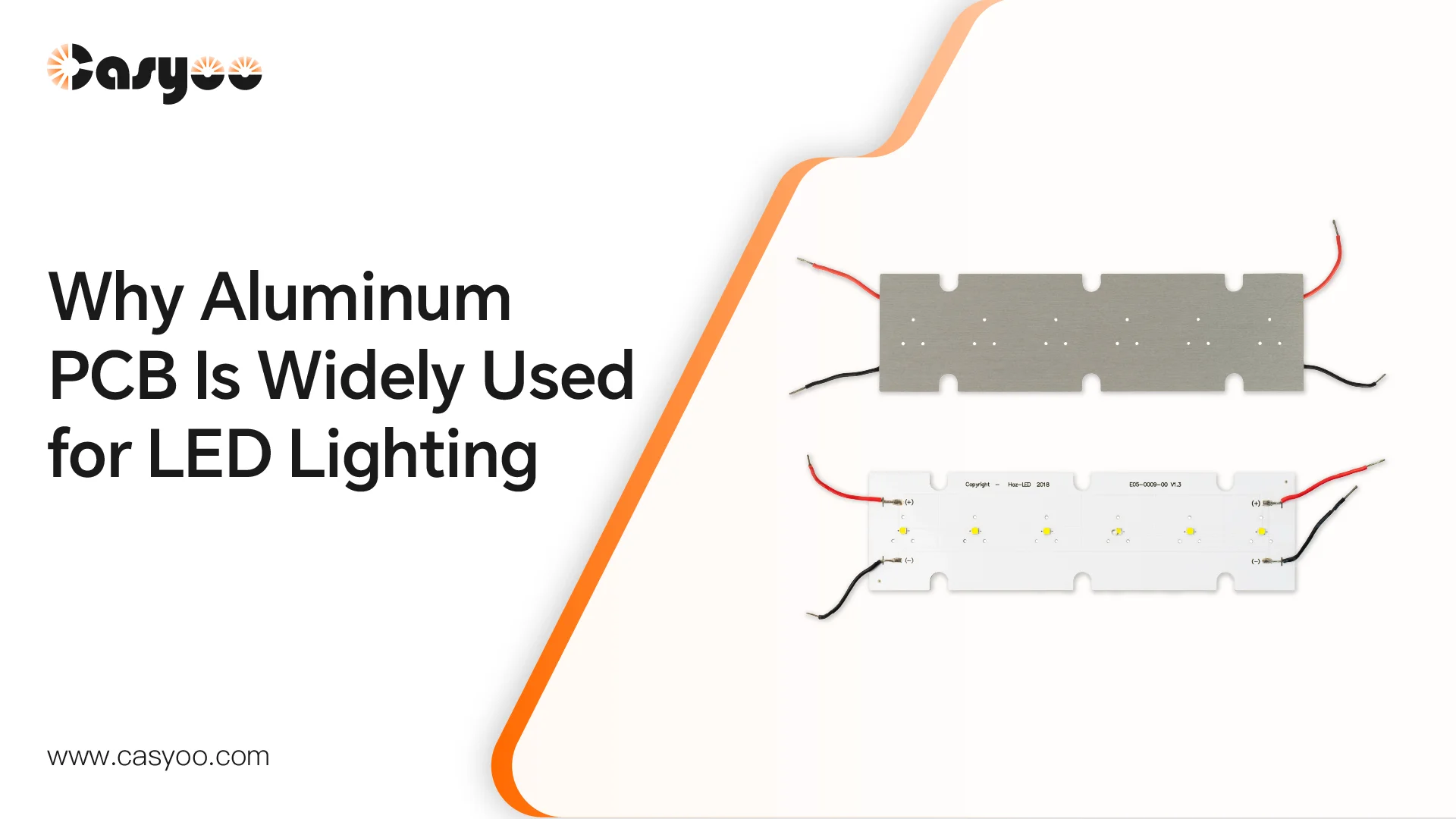
It’s a common assumption that LEDs run cool simply because they don’t burn like traditional bulbs. However, if you disassemble an LED fixture, you will often find a silvery-white metal plate mounted directly beneath the LED packages — the aluminum substrate that quietly does much of the work in keeping the LED cool. Though it may appear inconspicuous, it is a critical component that determines whether an LED can maintain stable illumination over the long term.
Aluminum PCBs (also called metal-core PCBs or MCPCBs) are a proven solution for the thermal challenges LED lighting presents. Understanding how this technology works can help you determine whether it’s the right choice for your next lighting project.
What Is an Aluminum PCB for LED?
An aluminum PCB is a type of circuit board that uses a metal base layer to conduct and dissipate heat away from mounted components. It is manufactured from aluminum instead of the fiberglass core used in standard FR-4 boards. A typical single-sided board normally consists of three key layers: a copper circuit layer, a thermally conductive dielectric layer, and an aluminum base layer.
Once an LED is soldered onto the board and powered on, heat generated at the junction travels through the dielectric layer into the aluminum base, where it disperses across a much larger surface area. The aluminum base itself often doubles as the mounting surface for an external heat sink, extending the cooling pathway even further.
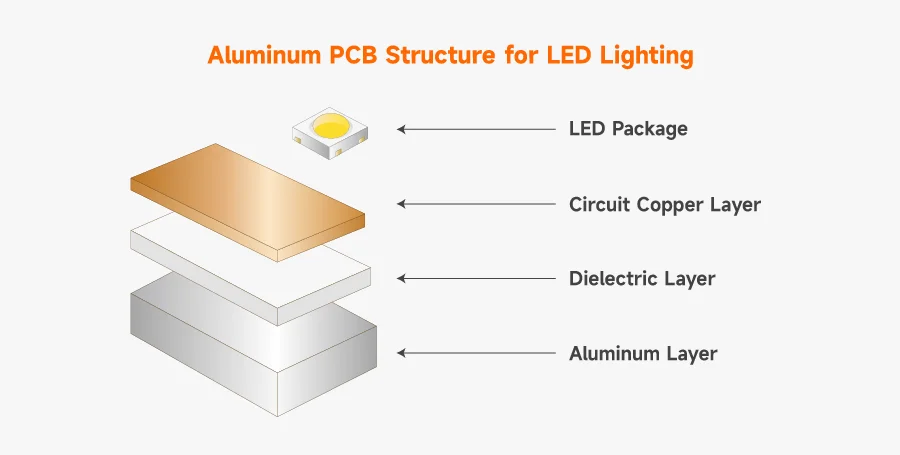
Aluminum has a high thermal conductivity, but the insulation layer’s thermal conductivity is low, so the thermal conductivity of aluminum PCB is limited. If the dielectric layer is too thick, it can slow heat transfer; if it is too thin, it may not provide enough electrical insulation, making the lighting fixture harder to certify for safety requirements.
Key benefits of Aluminum PCBs for LED lighting
A look at the ways in which aluminum PCBs improve LED manufacturing makes it clear that it’s a great fit:
Better thermal management
LED chips are small and getting more powerful. The intensity of the chips and the density of the components packed onto a board can be a challenge, particularly for high-power designs.
At the core of every benefit an aluminum PCB offers is its ability to move heat away from the LED more efficiently than a standard FR-4 board. As FR-4 has relatively low thermal conductivity, heat generated at the LED junction has a limited path to pass through the board and can build up around the component. Aluminum, by contrast, spreads heat more effectively across the board and toward the fixture housing or heat sink.
A longer product lifespan
Ever wonder why two LED fixtures from the same batch can look significantly different in brightness after two years? One of the primary causes is often due to uneven thermal conditions. LEDs do not usually fail outright, but instead fade gradually as sustained temperature accelerates aging in the phosphor and encapsulant.
An Aluminum PCB can help slow this degradation by keeping the junction temperatures low and stable. The brightness loss from a poorly cooled fixture may be greater than that of a well-designed metal substrate fixture (like aluminum) that will maintain closer to its rated performance for a longer service life. That difference matters most for products installed somewhere hard to reach, sold with long warranties, or expected to run for years without maintenance.
More stable light output
Nothing frustrates an end user more than lighting that dims unevenly or shifts in color over time. Heat is often one of the causes. As an LED’s junction temperature rises, luminous flux can fall and color output can shift. Aluminum PCBs address this problem at the board level by helping control temperature more evenly across the LED layout. The LED fixture’s temperature is more stable, which helps to keep the output consistent. It’s just as important for a single high-power spotlight as it is for a large installation where dozens or hundreds of fixtures must look the same side by side.
More compact fixture design
The aluminum PCB can be an integral part of the fixture’s thermal path, which means that you can save on the size of external heat sinks, venting or enclosures just to keep the components in safe operating temperatures. The board is not a part of the cooling system, but rather the cooling system.
This opens up design options that simply aren’t practical with standard boards. LEDs can be packed more densely without overheating, fixtures can be slimmer and lighter, and products can fit into spaces such as recessed lighting, compact indoor fixtures and other space-limited designs.
It’s not just a smaller size, either. Smaller, lighter fixtures are easier to ship, easier to install and in some cases can be used on a wider variety of products and applications without sacrificing the thermal performance that the design relies on.
Stronger mechanical support
Beyond thermal performance, the aluminum base also makes the board more resistant to flexing and warping compared to FR-4. This is a real advantage for outdoor LED fixture applications exposed to wind and temperature fluctuation, or industrial settings with vibration and repeated handling.
FR4 vs aluminum PCB for LED lighting
If the thermal load is low, FR-4 can still be a practical choice. Typically less expensive and is suitable for low-power LED modules, indicator lights and designs where heat is not concentrated in a small area.
This is not the case for medium- and high-power LEDs. However, FR-4 has a limited heat spreading capability even with wider copper areas, thicker copper or thermal vias, compared to an aluminum PCB. For higher LED density, longer operating hours, and a compact fixture housing, aluminum PCB is the more reliable choice.
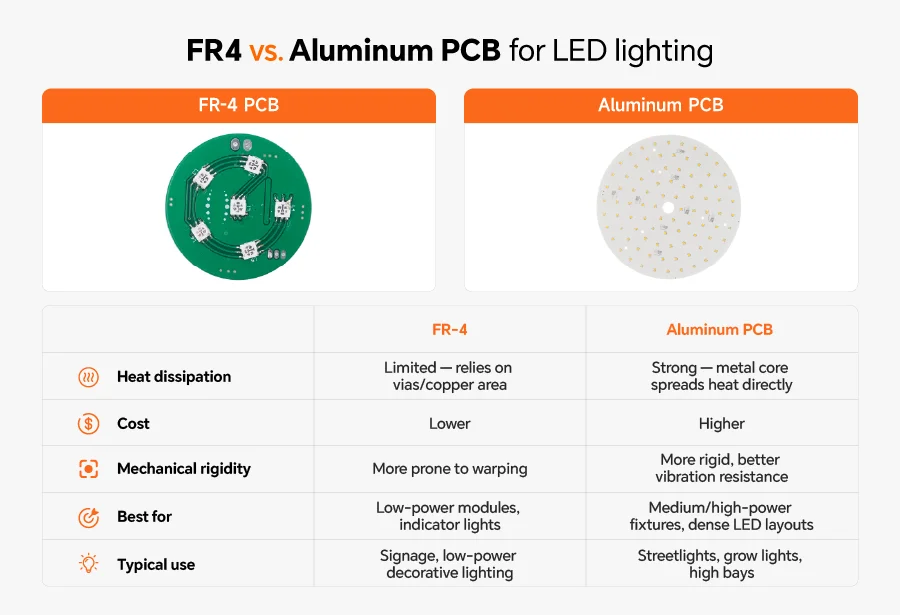
The right choice depends on the power level, LED layout, fixture size, operating environment, and lifespan requirements. FR-4 may lower board cost in simple low-power designs, while aluminum PCB provides a stronger thermal path for products such as street lights, grow lights, floodlights, and other high-output fixtures.
Common Applications of Aluminum PCB for LED Lighting
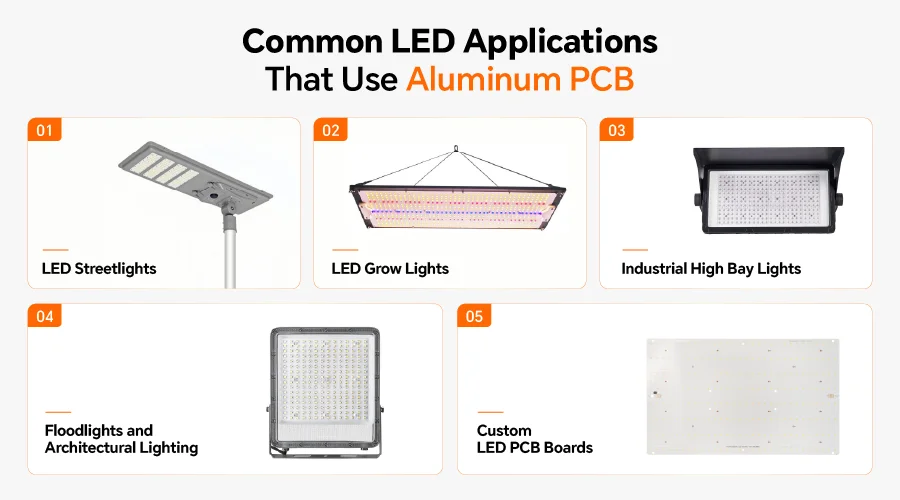
Widely used in outdoor lighting applications such as urban roads, highways, tunnels, and more. With power ratings ranging from 12W to 150W, these fixtures utilize high-thermal-conductivity aluminum substrates (such as 5052 or 6061 aluminum alloys) combined with fin-type heat sinks or extruded heat sink technologies to achieve both lightweight construction and extended service life.
Widely used in greenhouse cultivation, vertical farming, tissue culture rooms and indoor growing systems. Because grow lights often use dense LED layouts and long daily operating hours, their PCBs need reliable thermal management. Aluminum PCBs help spread heat across the board, reduce local hot spots, and support more stable light output for plant growth.
Industrial High Bay Lights
Mainly used in warehouses, factories, and large workshop spaces where fixtures are mounted at height and run for long duty cycles. When choosing an aluminum substrate type for these applications, power density, ambient temperature, and mounting height all need to be taken into consideration, since poor heat dissipation can shorten LED lifespan and make maintenance more difficult in these installations.
Floodlights and Architectural Lighting
Applied in stadium lighting, building facades, landscape lighting and outdoor lighting. These fixtures often combine high brightness with compact or sealed housings, so aluminum PCBs are commonly used to improve heat transfer and maintain stable output over extended periods.
Custom LED PCB Boards
Used for tailored LED lighting fixtures for particular applications where the standard options in the substrate do not apply. Depending on the project, the board shape, LED layout, copper thickness, dielectric material, and heat sink contact area may all need to be adjusted. Aluminum PCBs provide a more flexible solution for manufacturers to achieve specific thermal, structural and assembly needs.
How to choose the right Aluminum LED PCB provider
Choosing the right aluminum LED PCB provider makes it easier to move a lighting product from prototype runs to full production. Consistently delivering thermal performance, quality, and delivery. A good supplier like Casyoo will assist the board and the production of the LED product. When choosing an aluminum LED PCB provider for lighting applications, certain considerations are prudent:
- Do they understand your thermal and electrical requirements up front? Define the required dielectric thermal conductivity, dielectric strength, thickness of copper, board thickness, surface finish and insulation needs before selecting a material stack-up. The only way to find the right substrate is to know what you want the results to be.
- Can they hold quality consistent from prototype to full production? If the same performance cannot be reproduced at volume, then the prototype is not useful. Inquire about the supplier’s control of material thickness, copper weight, dimensional tolerances, solderability and dielectric properties within production batches.
- Do they support assembly and fixture integration, not just the bare board? There is a need for clear coordination between PCB fabrication, component assembly, heat sink installation and fixture integration in the manufacturers. It is impractical to use multiple suppliers to perform multiple parts of the process. Either the provider must be able to assemble the entire package or fit seamlessly into your current production line.
- Will they provide engineering support during design? Thermal performance and manufacturability can be impacted by small changes in LED layout, copper thickness, selection of the dielectric, or heat sink contact. A full design that covers thermal, electrical, and mechanical performance will take time to get right. Select an innovative supplier who is able to adapt rapidly to design changes and can provide DFM review throughout the process.
- Can they provide the testing and documentation you need? Depending on the application, buyers may need electrical testing, dielectric-strength testing, material certificates, inspection reports, thermal data, and batch traceability. These records are especially important for outdoor, industrial, and long-life LED products.
- Are the MOQ, tooling cost, lead time, and total cost suitable? There is a wide range of pricing structures for aluminum LED PCB projects. For example, some suppliers charge significant tooling and prototype fees that other providers absorb into volume pricing. Having to redesign a board after a costly prototype run can add up costs significantly due to the amount of time and rework it takes to correct the stack-up.
A reliable aluminum LED PCB provider should be able to support material selection, prototype validation, fabrication, assembly, and repeat production as one coordinated process. At Casyoo, our in-house manufacturing capabilities cover every step, with a focus on grow lights, streetlights, and more.
Looking for the right Aluminum PCB for your LED project?
Choosing an aluminum PCB is not only about selecting a thermal conductivity value. The right board also needs to match the LED layout, power level, fixture structure, assembly process, and expected operating environment. Through Casyoo’s OEM and ODM services, Casyoo is committed to helping you review your requirements and recommend a practical solution for your LED lighting project. Casyoo’s LED PCB is quality-based and customer-focused. It’s a manufacturer you can trust.
Want to learn more about Casyoo’s LED PCB board solutions? For more information, contact Casyoo for support and a fast quote.
FAQs about LED Aluminum PCB
Is an Aluminum PCB the same as an MCPCB?
Mostly, yes. MCPCB (Metal-Core PCB) is the broader category that can include aluminum, copper, or other metal substrates. An Aluminum PCB refers specifically to the aluminum version ans is by far the most common choice for LED lighting.
Can Aluminum PCBs be made as double-sided or multilayer boards?
Aluminum PCBs are typically single-sided, since the metal base serves as the thermal and mechanical foundation rather than a circuit layer. Double-sided or multilayer versions are possible for more complex designs, but are not as widely used and may not be available from all suppliers.
How much more expensive is an Aluminum PCB compared to FR-4?
It costs more than FR-4, mainly due to the aluminum substrate and dielectric material, with the exact difference depending on thickness, materials, and order volume.