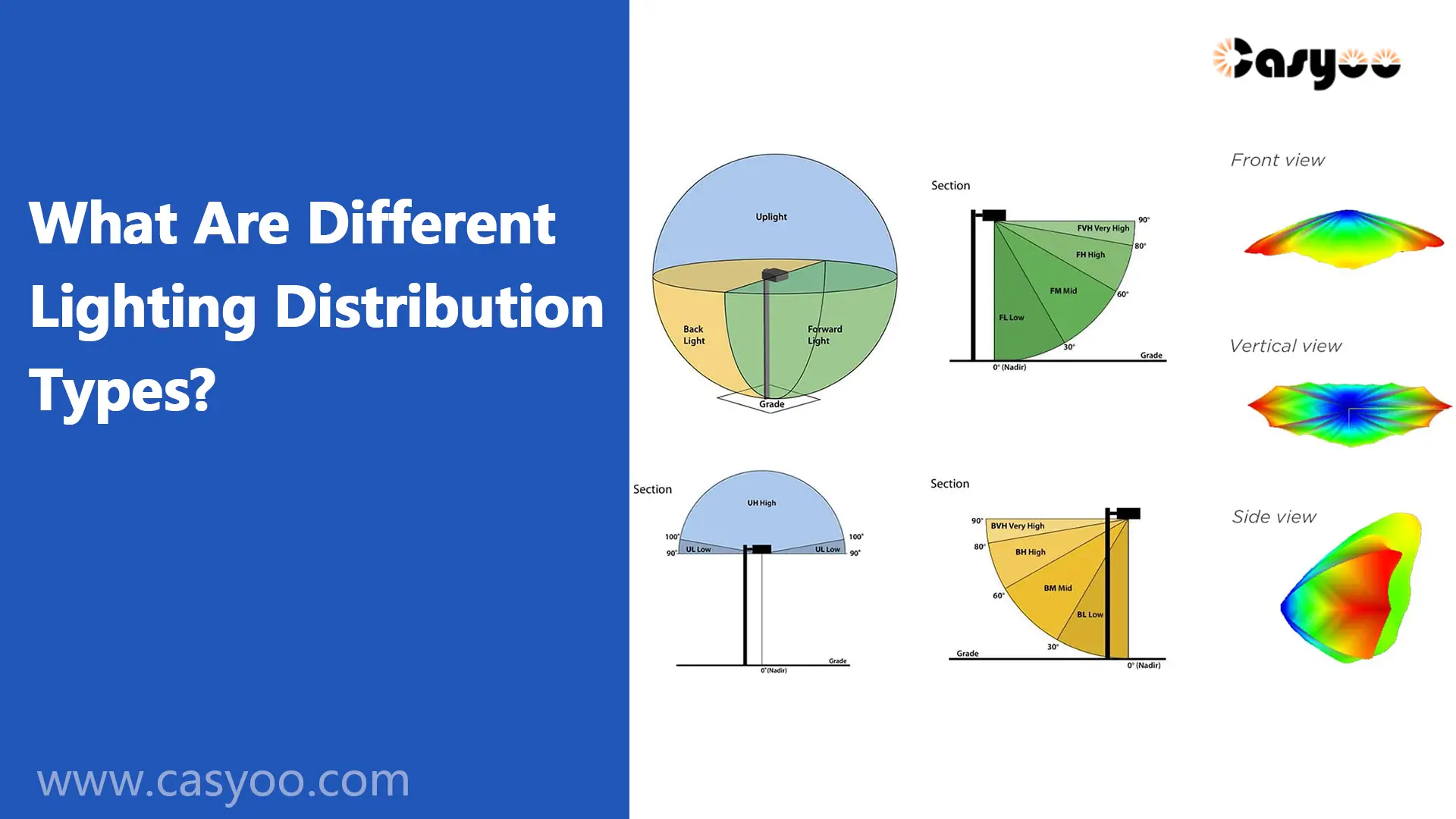
The light distribution is the intensity of light that a source emits in all directions. For LED street lights, proper light distribution is essential to ensure that all emitted light is efficiently utilized on the illuminated road surface. This is necessary to meet road lighting requirements. Here, we introduce the two most authoritative standards from IESNA and NEMA about lighting distribution types.
Types of Beam Light Distribution in IESNA & NEMA Standards
IESNA 5 types of lighting distribution
In the IESNA(The Illuminating Engineering Society of North America) standard, the light distribution of street lights is categorized into five types:
- Type I: Primarily used for narrow sidewalks or bicycle lanes. The lamp head situated in the center of the road. The lighting width is similar to the lamp height.
- Type II: Mainly for wider sidewalks, entrances to traffic lanes, or other long and narrow lighting applications. The light head is located on one side of the road, with the lighting width approximately 1.75 times the lamp height.
- Type III: Commonly used for highways, driveways, parking lots, and general square lighting. The lamp head is positioned on the roadside, with the lighting width 2.75 times the lamp height.
- Type IV: Typically for wall washing and large-scale parking lots, with a light pattern similar to a semicircle.
- Type V: Used for general parking lots and large-scale square lighting, with the lighting range forming a circle and the lamp head located in the center of the lighting area.
LED street lights primarily utilize three types of light distribution designs: Type I, Type II, and Type III, chosen according to the specific road type. Generally, the original light emission angle and intensity distribution of LED lights may not meet the requirements of a specific scene, so secondary light distribution is essential. One way is to disperses light to form a larger angle, creating a more uniform light spot. Another way is to concentrates light into a smaller range to increase the central luminous intensity. The light distribution of Casyoo LED lights is well designed, and can fit various applications.
NEMA beam angle and light distribution
NEMA(National Electrical Manufacturers Association) outlines seven types of light distribution, each representing a specific beam angle, beam width, and projection distance as the following table. It is mainly used to categorize floodlights and spotlights.
| Type | Beam Angle | Beam Width | Projection Distance |
| 1 | 10-18 | Very Narrow | >72 |
| 2 | 18-29 | Medium Narrow | 60-72 |
| 3 | 29-46 | Narrow | 52-60 |
| 4 | 46-70 | Medium | 43-52 |
| 5 | 70-100 | Medium Wide | 32-43 |
| 6 | 100-130 | Wide | 24-32 |
| 7 | >130 | Very Wide | <24 |
The categories describe the distribution of light from both horizontal and vertical directions. For instance, a light with a horizontal angle of 80 and a vertical angle of 120 corresponds to NEMA 5×7.
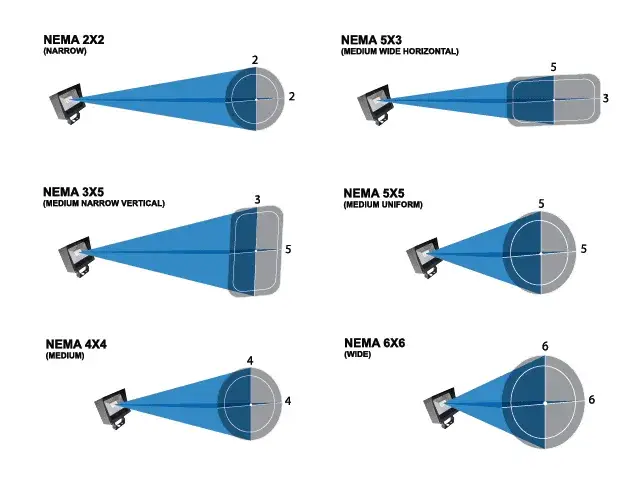
Common beam angles include:
- NEMA III/NEMA IV: These provide a circular light distribution with a relatively small beam angle. They are suitable for small sports fields, and high bay lights also apply these types.
- NEMA 5×3: This type offers a rectangular shape of light distribution commonly used in street lighting. Its shape resembles the roads, minimizing energy waste.
- NEMA V: This type provides a wider circular light distribution and is suitable for larger spaces, such as warehouses.
- NEMA VI: Some flood lights use this light distribution type for wider illumination. This design makes them suitable for garden lighting, architecture lighting, and similar applications.
NEMA vs. IESNA: Which Light Distribution Standard to Choose?
Most frequently when designers encounter various kinds of lighting projects they have to decide between two significant standard systems: NEMA (National Electrical Manufacturers Association) and IESNA (Illuminating Engineering Society of North America). Essentially, these standards are different approaches to lighting design. In the former, floodlight beam angles hold the priority, whereas in the latter, distribution on the horizontal plane is the priority.
NEMA Standards
The NEMA standard is specifically concerned with beam spread angles, and therefore the standard is particularly relevant in applications where it is necessary to have wide continuous illumination. One simple example is a parking lot, where NEMA Type V or VI fixtures tend to work best. They can provide almost circular symmetrical beam patterns that provide equal coverage across all directions.
NEMA classification is easy to understand and simple to work with. A designer does not need to engage him or herself in the complicated photometric information, but a straightforward procedure of choosing the correct type. However, the NEMA system lacks descriptions of such details as values of light intensity and uniformity and, therefore, is not as practical in those tasks where a fine control over light is necessary.
IESNA Standards
As an authoritative institution in the North American lighting field, IESNA provides a more comprehensive standard that covers everything from photometric calculations to lighting quality evaluation. The most evident of its qualities is the focus on the horizontal distribution of light, and it is particularly appropriate where the specifics of light are essential. One such example is road lighting. Specifications like IESNA RP-8 not only stipulate minimum illumination levels but also elaborate on how to ensure an balance between visual efficacy and economy.
Overall, NEMA system would be more appropriate in large-area flood lighting applications like parking lots and warehouse areas. In contrast, IESNA standards dominate professional markets where precise distribution is needed, such as in road lighting and sports arenas.
Conclusions
In conclusion, different LED lights feature distinct light distribution designs. Understanding these variations is crucial for selecting the right lighting solution. Adhering to the standards set by IESNA and NEMA ensures the appropriate selection of LED lights that provide sufficient illumination without energy waste. It is wise to consult an experienced LED manufacturer like Casyoo to get the specific lighting design for your space.