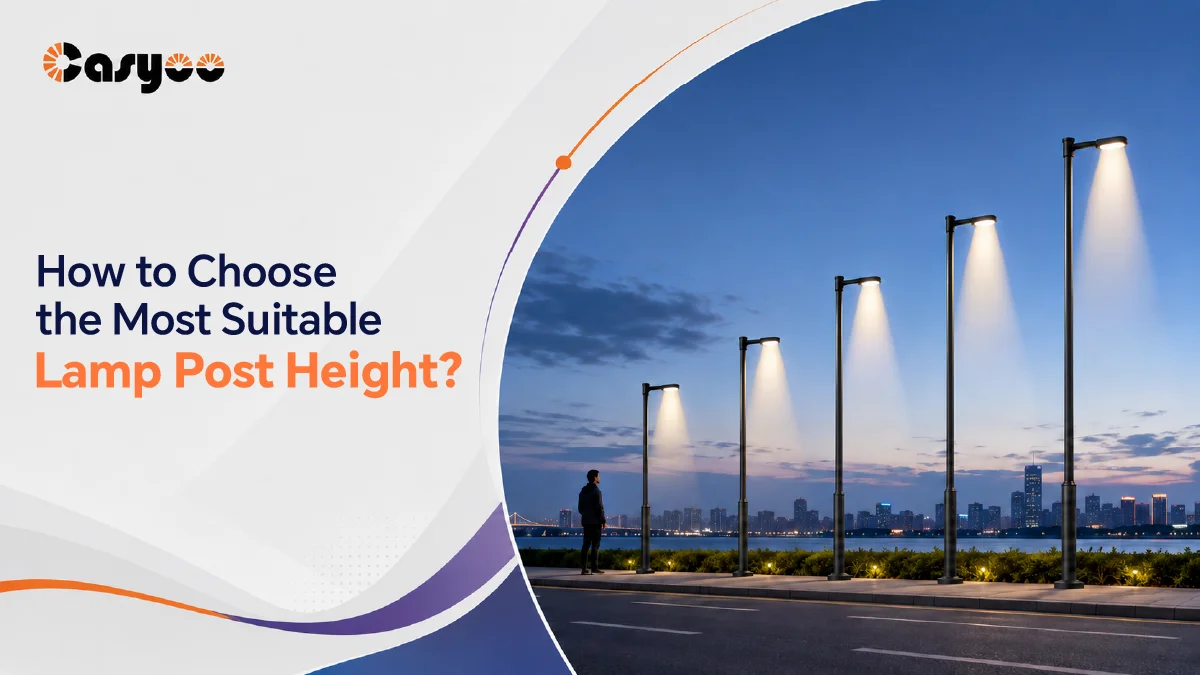
There are a myriad questions to answer before you choose a lamp post height. Everything from the fixture’s light output to the road’s width to the spacing between poles must be carefully weighed together. Get it wrong, and you won’t find out right away. For example, dark patches creep in between poles, glare complaints from drivers, or the spacing plan falls apart once fixtures go up. We’ll begin with how pole height of street lights affects lighting performance, key factors, then pole spacing and pole heights, and suggested height ranges for various applications.
How pole height affects lighting performance
The lighting effect of the same fixture will be significantly different when mounted on a 6m pole versus a 12m pole. With the fixture’s light distribution staying the same, a higher mounting height means the light travels farther. So less light will reach each unit of ground area, and illuminance drops.
The drop can be steep. Under ideal conditions, if this is done, the illuminance directly beneath the light will be about one-quarter of its value when the mounting height is doubled from 6 to 12m. That’s the reason why taller poles often require a higher lumen output. Height also changes where the light ends up. The taller the poles are, the more light tends to spill outside the target zone. It is not only the fixture’s lumen output that matters, but its beam distribution and optical efficiency.
Lamp post height shapes more than illuminance. It also affects uniformity, glare, and shadows. A tall pole generally gives wider coverage of light, smoothing out the illuminance transitions between adjacent areas, and therefore, making the light more uniform. But if the fixture’s output is insufficient or its distribution doesn’t match the application, increasing the height can still leave inadequate ground illumination. Glare tends to drop because the light source is farther from drivers or pedestrians and less likely to fall directly within their line of sight. Lower poles do just the opposite. They focus light more tightly under the fixture, resulting in a sharper contrast in brightness between adjacent areas and creating longer, more defined shadows.
Key factors that determine lamp post height
The application scenario is first and foremost. This includes road function, width, vehicle speed, pedestrian density, necessary lighting coverage, and more. Generally, taller poles find more adoption in high-speed roads and major urban streets, as the lighting has to cover greater distances and, particularly, to give drivers continuous visibility. At the other end are the residential streets, sidewalks and garden paths. These are pedestrian-focused areas and low poles can bring close-range comfort and uniformity.
Photometric distribution matters just as much. For example, a wide-beam fixture on a 12m highway pole can cover a full carriageway. If mounted on a 4m pedestrian post, most of that output may spill beyond the intended area, a waste of light and unnecessary energy use. Narrow-beam optics work the other way, suitable for a lower post.
The site itself can also limit how high a pole can be installed. The pole’s ability to withstand wind load and snow weight is of great significance; the taller the pole, the higher the requirements for its structural strength and stability. Physical obstructions matter too. Even if you have the best paper design of height and beam, buildings, trees and billboards along the road can block the light and reduce the effective coverage of the fixture.
In addition, different regions may have different road lighting standards, and the final pole height should comply with local requirements.
How pole height affects pole spacing
Pole height and spacing work as a pair that should be both considered in road lighting design. A taller pole lets light cover more ground, so it’s possible to space poles farther apart and light more road with fewer of them. Shorter poles, conversely, need tighter spacing to avoid dark areas. As a first check during project planning, engineers often start with a spacing-to-height ratio of 2.5 to 4 times the pole height.
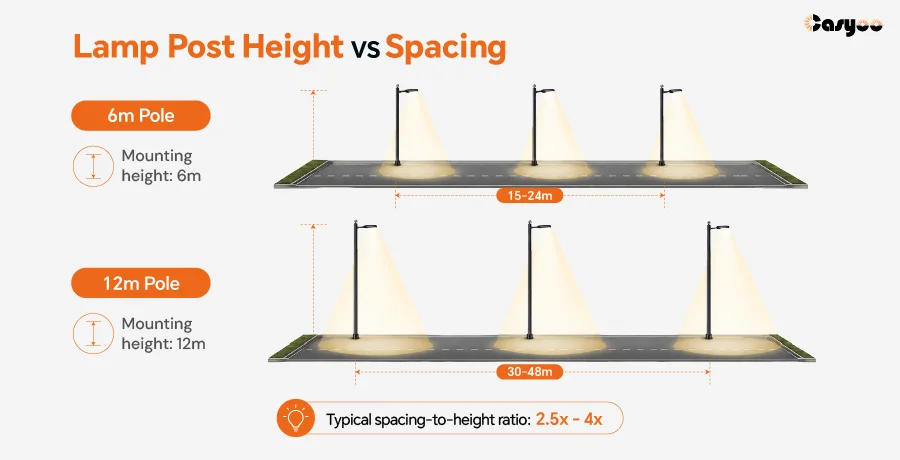
A 6m pole might land around 15 to 24 meters of spacing; a 12-meter pole could stretch that to 30 to 48 meters. In practice, these numbers still get adjusted depending on road width, beam distribution, mounting method, and lumen output. Push spacing too far, and dark zones creep in. Pull it too tight, and illumination overlaps. Of course, the ratio is just a reference. Most engineers use tools like DIALux or AGi32 to simulate lighting layouts based on the fixture’s IES file and actual site conditions.For a quicker estimate before running a full simulation, you can also try Casyoo’s height and spacing calculator to get a reference spacing range based on your pole height.
Recommended lamp post heights for different applications
The right height depends on the setting. Coverage needs, visual comfort, and safety requirements all shift from one application to the next, and so does the ideal mounting height. Here are reference ranges for light pole heights in several common applications.
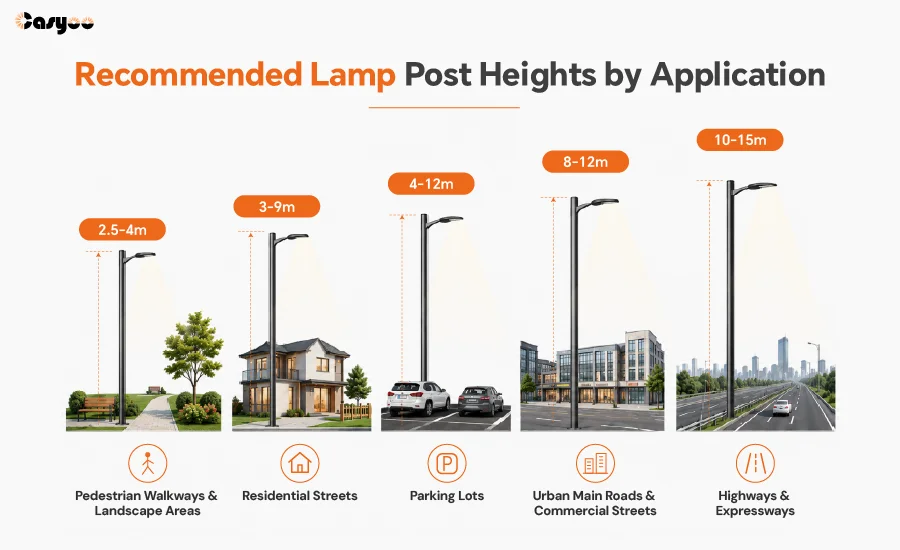
Pedestrian walkways and landscape areas
2.5 to 4 meters of pole height covers most of this category. At this height, light stays concentrated on the walkway and nearby seating or activity areas rather than spreading into the distance. This also reduces the amount of glare and makes the whole space feel closer to human scale.
Residential streets
Normally 3 to 6 meter poles are used on narrow community roads; 9 meters or more may be required on wider residential roads. The traffic here moves slowly and the roads aren’t very wide, so raw coverage matters less than ensuring pedestrians and drivers are able to see each other, and that light does not fall on bedroom windows overnight.
Parking lots
Lamp post height in parking lots depends heavily on site size. Small lots, like those beside office buildings or hospitals, usually use 4 to 6 meter poles. If you move up to a medium-sized lot, then 6-8 meters in bidirectional distribution, the one pole will cover twice the ground. 8-12 meters or taller is common in large lots at malls or commercial centers, and often combined with a wider beam, primarily to reduce the number of poles and foundations required in the project.
Urban main roads and commercial streets
This can range from 8-12m, due to both heavy traffic volumes and multiple lanes. The surroundings, business blocks and houses close to the road make this category more challenging than the others, as beam shielding is a critical issue or spill of light is a source of complaints.
Highways and expressways
10 to 15 meters, sometimes to a higher height at major interchanges. Glare control is even more critical in this scenario, as the vehicle travels at high speeds and the light source should be well positioned to avoid the driver’s direct line of sight while illuminating the road surface uniformly.
Common mistakes to avoid when selecting pole height
Assuming taller poles always provide better lighting
Taller isn’t automatically better. If a pole height is increased but the lumens are not, and the beam is not suited to the new height, then it’s likely that the ground under the pole is going to be under-lit, even if it does cover more on paper. This is usually discovered later after installation, when the light on the roads is dim at night.
Choosing pole height before selecting the fixture
A common sequence on many projects: height of the pole is determined during early planning and the fixture is ordered after. The two don’t always cooperate. A narrow-beam fixture that’s installed at a height designed for wide optics creates dark areas at the road’s edge. A wider-beam fixture on a low height over narrow optics will not cover much ground directly under the fixture. This can be avoided by determining height and fixture at the same time.
Using the same pole height for every application
A highway spec dropped onto a garden path is both wasted and a cause of glare. The opposite, a walkway spanning a wide arterial road, results in dark spaces between poles. Numbers for each zone must be different for lighting uniformity .
Conclusion
To get the proper pole height, it is not simply a matter of picking a number from a chart. It’s that decision that determines the fixture, the spacing and the budget, and it doesn’t often show up until the poles are down in the ground. Casyoo supports project teams on lighting projects of any size, offering a variety of street lights as well as solar lights. If you have an upcoming project and are considering height and spacing, send us the details and we will be able to assist you.
FAQs about lamp post height
What is the standard lamp post height?
There is no universal height for all situations. The actual selection will vary depending on the road type, coverage requirements, and lighting objectives. Common ranges include roughly 2.5 to 4 meters for pedestrian walkways and gardens, 3 to 9 meters for residential streets, 8 to 12 meters for urban arterial roads and commercial streets, and 10 to 15 meters for highways and expressways.
How do I know if a lamp post height is suitable?
Three things usually confirm it: the ground illuminance level is adequate for the application, dark areas are not noticeable between poles, and excessive glare is not observed during use. For large-scale roads or more complex lighting projects, it’s best to verify the choice with lighting simulation software like DIALux, rather than relying solely on general height guidelines.