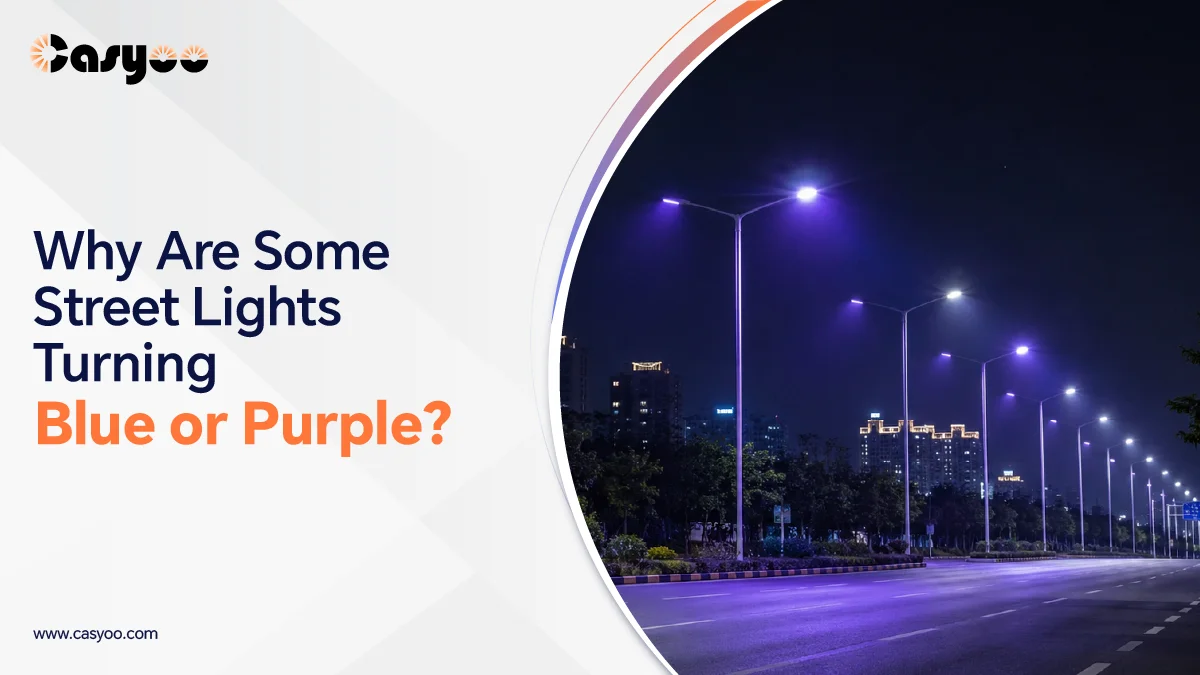
The fixture looks fine. The pole looks fine. Even the power supply, when you check it, reads a normal voltage. But night after night, the light coming out of the streetlights is the wrong color, and this isn’t an isolated case.
I’ve found that most people’s first instinct is to look for something dramatic such as a wiring fault, a bad batch of LED modules, or a smart fixture malfunctioning. In many reported cases, the driver and power supply usually work normally. The real problem is inside the LED package – a few square millimeters of silicone that sit directly on top of the LED chip, and it’s unglued.
In this guide, we’ll discuss some of the reasons why a “white” street lights turning blue or purple, what’s actually failing inside the fixture, and what fixing it does and doesn’t require.
White LED light isn’t actually white light
Just to begin with, there is no such thing as a “white LED”—that is, a chip that emits white light directly. At the core of most white LEDs is a blue diode coated with phosphor; this phosphor is a special compound designed to convert the light emitted by the blue LED into broad-spectrum white light. The diode itself emits blue or violet light, and a thin layer of phosphor coating its top absorbs some of this blue light and re-emits it as light with longer wavelengths (such as yellow, green, or red). Consequently, the light reaching the human eye is a mixture of unconverted blue light and the warm-colored light emitted by the phosphor. As long as the mixing ratio is correct, white light is produced.
The streetlights causing this issue use a special design known as chip-scale packaging (CSP) LEDs. They employ a layer of silicone-based phosphor, roughly the same size as the chip, that is directly bonded to the LED’s surface to convert the blue light into the white light required for street lighting. This design lacks a diffuser and does not feature a separate phosphor puck placed above the chip, as in earlier LED packages—the conversion layer is bonded directly to the chip.
The white light you see is not a property of the diode itself, but rather a property of the thin film glued to the diode. If that film comes off, the original color of the light emitted by the diode will shine through directly.
Why do some street lights look blue?
LED phosphor layer failure
It’s easy for us to assume that the phosphor is just like paint: once applied then it stays forever. This is not the case. It is actually an adhesive bond between two materials: a rigid semiconductor chip and a flexible silicone film, and, indeed, it’s in this bond that failure is most likely to occur. A U.S. Department of Energy investigation confirmed this: LSRC evaluated 28 field-failed modules from one manufacturer, submitted by North Carolina’s DOT, and traced the failure to the silicone phosphor layer.
LED street lights generate heat continuously during operation. In particular, they are sealed inside a housing and need to operate for long periods every night; that heat will accumulate right in the adhesive layer between the phosphor and the silicone. Strains may also be added by repeated vibration from passing vehicles and the simple, continuous pull of gravity. Taken individually, none of those forces is large in an instant, but all of them are persistent, night after night, for years.
Once the phosphor-silicone bond fails, there is no longer a light-conversion layer standing between the diode and our eyes. Fine cracks in the phosphor layer let a small amount of blue light leak through; in more severe cases, the phosphor may detach completely, causing the fixture to emit purple or blue light rather than simply dimming. This is the most common mechanism behind street lights turning blue in the field. However, this failure often causes uneven light, which means some LEDs in the same module stay white while others turn blue or purple.
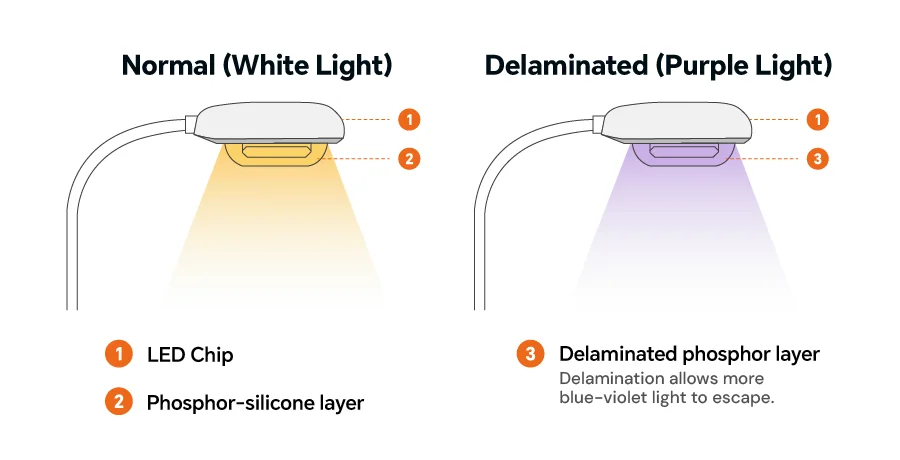
If the LED chip itself were defective, the light would simply go dark, and there would be no shift in color. And a chemical breakdown of the phosphor material (i.e., the compound itself degrades, rather than flaking off) would produce a gradual fade from white toward off-white, not the sharp jump to blue or purple that shows up in the field.
High color temperature LED street lights
The second cause is a fixture performing exactly what its color temperature rating says it should. A 2700K LED carries roughly 15% blue content; move up to 3000K and that rises to about 21%; at 4000K, it’s closer to 32%.
Many cities retrofitting to LED are opting for a higher 4000K or even 5000K for their efficiency and their crisp, daylight-like appearance. The higher color temperatures are, naturally, cooler and may be blue-white when compared to the warmer white light around 3000K. This is usually a result of the lighting design itself and not a failure, if a fixture has been like this since it was installed, and has not deviated further toward the blue/purple spectrum over the years.
Intentional blue lighting for special locations
In rare cases, blue street lighting is an intentional choice in urban lighting design. Some train stations, for instance, have experimented with blue lighting to change the spatial atmosphere and reduce impulsive behavior, or used it in crime prevention efforts to draw attention to an area and serve as a psychological deterrent.
Are blue street lights harmful?
Glare and visual discomfort
This is the complaint that comes in loudest and fastest. As the blue light has a shorter wavelength, it scatters more easily and causes more visual irritation than warmer light. The light will not be properly controlled if there is also an exposed light source, inadequate optical design, or excessive brightness of the street light, which will induce eye strain, visual fatigue and less comfort.
Color recognition and road visibility
A street light with a damaged phosphor layer often lacks red and yellow wavelengths in its spectrum, leaving mostly blue-purple light. This reduces color rendering, making pedestrians’ clothing, road markings, and vehicle colors look distorted, and traffic signals or brake lights harder to identify accurately. There’s also a quieter problem here: a road with white, blue, and purple fixtures side by side forces drivers to keep readjusting to a changing visual environment, which becomes especially tiring at night.
Possible effects on sleep
Blue light suppresses melatonin more strongly than other colors of light, and thus it’s more likely to disrupt sleep. But white LED streetlights are estimated to be 5 times as effective as high-pressure sodium lights at suppressing melatonin, according to the American Medical Association. Based on this, the AMA suggested to maintain an outdoor light source of 3000K or less.
Effects on wildlife and insects
Short-wavelength blue light scatters more easily in the atmosphere, making skyglow worse and interfering with the natural light cycles that are important for wildlife. These lights also attract nocturnal insects, and may disrupt their normal feeding and breeding habits.
How to prevent blue or purple color failure in LED street lights
For LED manufacturers, street lights turning blue or purple is not merely a product quality issue. It also impacts brand reputation and future orders. If discoloration has occurred after only one or two years in service, it will probably be a big job of replacement, and the loss of trust is far more costly than the replacement.
Such failures cannot be predicted by the lumens or colors at shipment. The key lies in whether the bonding layer between the silicone and the phosphor can withstand years of thermal cycling, a factor that no spec sheet will reveal. Since faults are often traced back to certain production runs, in these cases, batch tracking matters more than local site tracking. Once a failure is confirmed, the rest of that batch should be placed under close attention. What’s more, monitoring should focus on changes in light color, not brightness, as a delaminating module may be able to run at close to full output undetected by any of the electrical checks. When one module goes bad, it cannot be repaired on-site (re-bonding is not possible) and must be replaced.
Conclusion
In short, street lights turning blue or purple is not some new lighting trend, nor does it necessarily indicate a serious safety hazard. Typically, the problem does not lie in the external structure of the fixture. Waiting until widespread discoloration occurs and then replacing the fixtures one by one is a costly remedial measure. Getting the design and manufacturing quality at the source is the more economical and efficient approach. Casyoo has always regarded long-term color stability as a core indicator of streetlight quality and is committed to ensuring that every light maintains stable and consistent color performance throughout its entire service life. Just contact us to learn more about the Casyoo LED streetlight series.
FAQs about blue or purple street light
1.Why do only certain LED streets turning blue?
These are related to batch differences, time in service, environment at installation, and consistency of the manufacturing process. If the materials or operating conditions differ from fixture to fixture, even if they are installed on the same day, they can vary in color.
2.What color temperature is best for street lights?
There’s no single color temperature that works for every road. Modern street lighting typically uses LED fixtures in the 3000K to 5000K range, with the right choice depending on road type, traffic conditions, local lighting standards, and visibility needs.
3.Is it safe to drive under blue or purple street lights?
Passing under a blue street light briefly generally doesn’t pose a significant health risk. But if a large number of fixtures along the same road have shifted color, the added glare and reduced color rendering can genuinely affect driving comfort and road visibility.