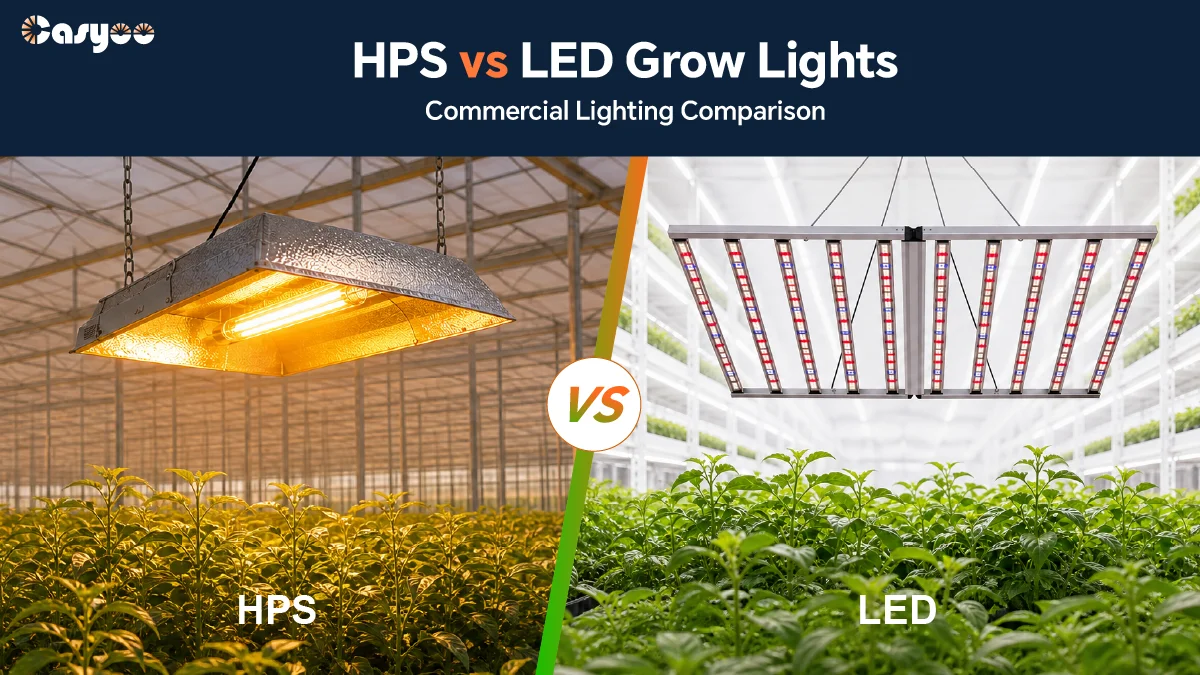
Plants need light to grow, but natural light is not always sufficient for modern cultivation. The adoption of grow lighting isn’t just about keeping plants alive. It’s about maximizing yield, controlling costs, and preparing for long-term growth. From rising electricity bills to heat stress and uneven light coverage, grow lighting in commercial operations has evolved far beyond simply hanging a bulb over the canopy. Today’s most popular grow lighting technologies are the two that are most commonly compared: HPS and LED. Read ahead to learn more about the pros and cons of HPS vs LED grow lights, and how each technology is being used to shape modern plant cultivation as we know it.
HPS vs LED grow lights: an overview
What are HPS grow lights
High-pressure sodium (HPS) lamps are a type of high-intensity discharge (HID) lamps that generate light by passing an electric current through sodium gas in the discharge tube. When operating, a stable arc is established inside the tube, resulting in light that has a high yellow-orange color. One of the most recognizable features of HPS lighting is the strong yellow-orange color of the light. Having a well-developed technology base and decades of real-world experience, HPS was one of the first grow lighting solutions to be commercially adopted. It has been used for many years in greenhouses and other controlled agriculture settings and is still used in some growing operations today.
What are LED grow lights
LED (light-emitting diode) is a solid-state semiconductor device that emits light as a result of the recombination of electrons and holes with the release of energy. Unlike conventional gas discharge light sources, LEDs produce light directly by means of semiconductor chips instead of an electrical discharge process. This enables manufacturers to mix LED chips with various wavelengths to produce custom light spectra that are more conducive to plant growth. With the continuous development of semiconductor lighting technology, LED grow lights are now widely used in plant lighting in various fields such as greenhouses, vertical farms, and indoor plant cultivation.
Key differences between HPS and LED grow lights
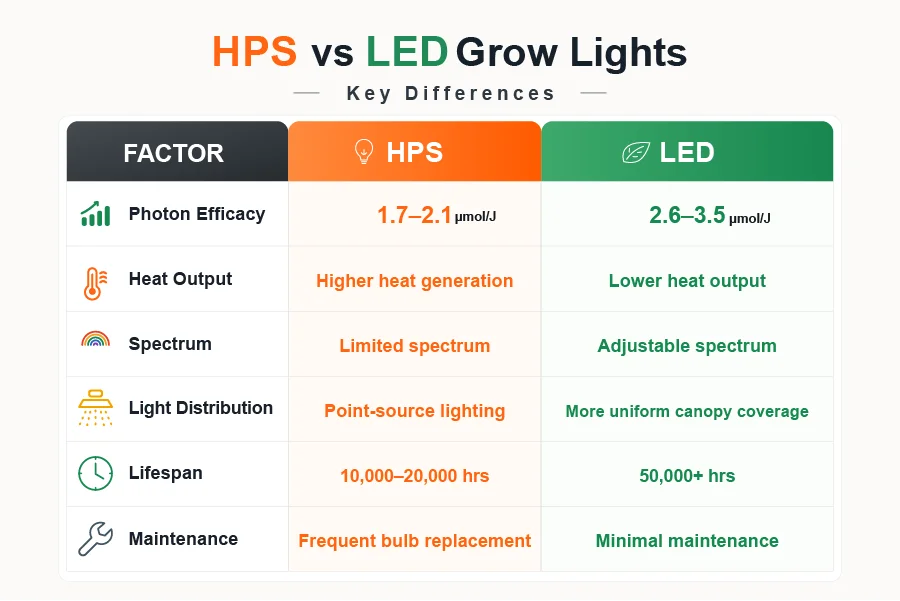
Here’s an overall comparison of HPS vs LED grow lights:
Energy efficiency
Energy efficiency is one of the most basic differences between HPS and LED, and directly influences long-term running costs. One of the most important indicators of lighting efficiency is photon efficacy (PPE), measured in μmol/J, which represents the number of photosynthetically active photons generated per joule of electricity used. The current mainstream HPS fixtures are around 1.7-2.1 μmol/J, and good quality LEDs are around 2.6-3.5 μmol/J. This means that LEDs typically can provide the same or better supplemental lighting performance at lower power. For example, a 1000W HPS can be replaced with a 650-700W LED fixture and can deliver a comparable light output. This efficiency gap continues to widen the gap in electricity costs over time.
Heat output
The heat characteristics of HPS and LED grow lights are quite different, because of their different light-emission mechanisms. HPS fixtures produce a lot of heat when operating and a lot of that heat is emitted as infrared radiation towards the plant canopy, which can increase the temperature of the growing area. LED fixtures, however, focus the majority of their heat in the fixture’s heat dissipation system. This means that they tend to cause less thermal stress to plants and are easier to keep the growing environment stable.
Light spectrum
One of the major influences on plant growth is the light spectrum, particularly the wavelengths within the PAR (Photosynthetically Active Radiation, 400–700nm) range that plants can actually use for photosynthesis. HPS lighting is primarily in the yellow, orange and red wavelengths and has relatively low blue light output. This is why HPS has traditionally been favored for flowering and fruiting stages, although its support for the blue light requirements of vegetative growth is more limited. LEDs, on the other hand, can be made with a combination of different wavelengths, including blue, red and far-red light. Some LED grow lights also offer growers the ability to adjust the spectrum ratio, which can help to better match the needs of plants at various growth stages.
Light distribution
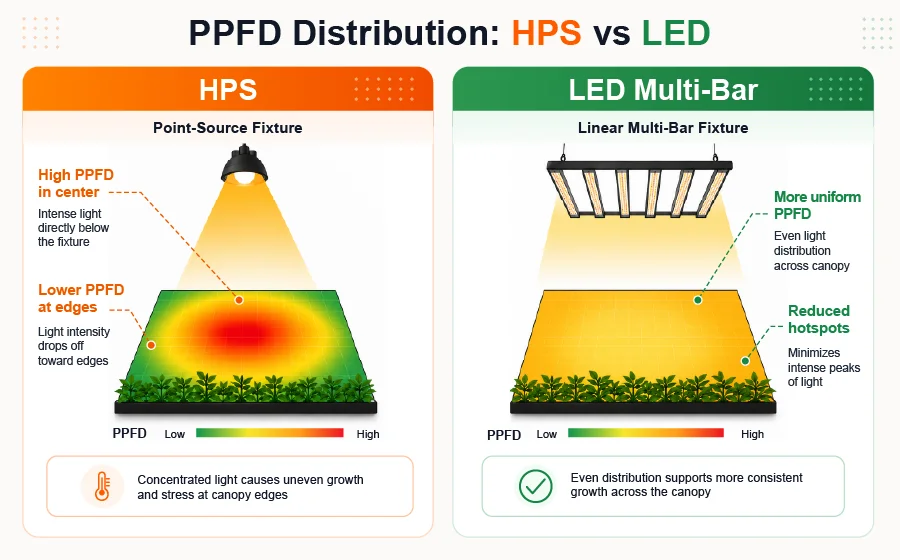
HPS is a point-source lighting technology, which produces a more concentrated beam of light that can penetrate deeper into dense plant canopies. However, its light distribution is relatively less uniform, meaning PPFD (Photosynthetic Photon Flux Density) directly below the fixture may be significantly higher than at the edges of the growing area. LED grow lights are typically made up of multiple light-emitting units arranged across a larger panel or light bar. This design allows them to deliver more even PPFD coverage across the canopy, helping reduce shadows and areas of excessive light intensity.
Cost
HPS and LED are two very different investment models in terms of cost: low upfront cost, high operating cost versus high upfront cost, low operating cost. LED systems usually have a higher initial cost, whereas HPS fixtures and their ballasts are generally more affordable. But LEDs are more energy efficient and maintenance free, so they can be more cost effective over long periods of continuous use. HPS might still be a viable option for projects on a tight budget, and LED may be the better choice for long-term commercial operations due to its overall economic benefits.
Lifespan & maintenance
HPS bulbs are rated for 10,000 to 20,000 hours and their light output will fade over time and should be replaced regularly. In contrast, LED fixtures typically have a lifespan of over 50,000 hours and have a gradual light fade, which means they require less frequent replacement and maintenance. However, the actual lifespan of LED grow lights can still be affected by factors such as the driver, thermal management, and operating environment.
Why more growers are transitioning from HPS to LED
Many commercial growing operations – whether greenhouses, indoor farms, or vertical farms, etc. – are increasingly moving towards adopting LED lighting. Several key factors are driving this transition:
LED fixtures are becoming more affordable, so more growers and operations can adopt high-performance lighting systems without requiring the high upfront investment that previously limited LED adoption in some applications.
The rise of energy costs across many regions, where electricity now represents a growing share of operating expenses, pushing growers to pay more attention to lighting efficiency and long-term electricity consumption. A 2017 DOE report found a 24%-30% reduction in electricity use for LED versus HPS and other conventional lighting.
LED grow lights are becoming much more controllable and precise, allowing growers to fine-tune spectrum, intensity, and photoperiod within a single LED lighting system.
Due to these trends, the need for switching from HPS to LED lighting to reduce energy costs and improve growing precision has become increasingly crucial, particularly for certain applications we shall detail later.
By focusing on the shift to LED, growers can reduce long-term operating costs and gain greater control over crop quality and yield.
Best applications for HPS and LED grow lights
Best use cases for HPS
Limited initial budget
Since HPS fixtures and their ballasts typically cost less to buy than LED systems, HPS remains a cost-effective option for projects that are sensitive to upfront spending, or for growers just running a short-term trial.
- Cold growing environments: In colder regions or growing environments with naturally low temperatures, the heat generated by HPS can help reduce the need for additional heating to some extent. This gives HPS continued value in certain cold-climate applications.
- Existing HPS facilities: For large-scale commercial facilities where HPS systems are already installed and the equipment remains in good working order, continuing to use HPS is often more economical than a complete upgrade to LED. Consequently, some established growing operations continue to use HPS, depending on the condition of their equipment and their upgrade plans.
Best use cases for LED
- Long-term commercial cultivation: For commercial growing facilities designed for long-term operation, the lower electricity, maintenance, and climate control costs of LED systems become increasingly valuable over time, giving them a stronger advantage in overall operating costs. This benefit is often even more noticeable in regions with high electricity prices.
- Indoor farms and space-limited growing: In space-constrained growing environments, such as small grow tents or multi-layer vertical farming systems, the lower heat output and flexible installation options of LEDs can reduce the pressure on environmental control systems while improving productivity within limited space.
- Precision growing and crop optimization: LED systems can also be dimmed and have adjustable spectrum, enabling growers to fine-tune their lighting strategies for various crops and growth phases. This control can be used to maximize the quality of the crop and improve the yield of certain compounds, including cannabinoids and terpenes, which is much harder to do with HPS.
HPS or LED: which grow light should you choose?
Once you have an understanding of the characteristics, differences, and appropriate uses of HPS vs LED grow lights, the final decision will depend on your cultivation requirements and objectives. The following are some factors that are especially important to consider:
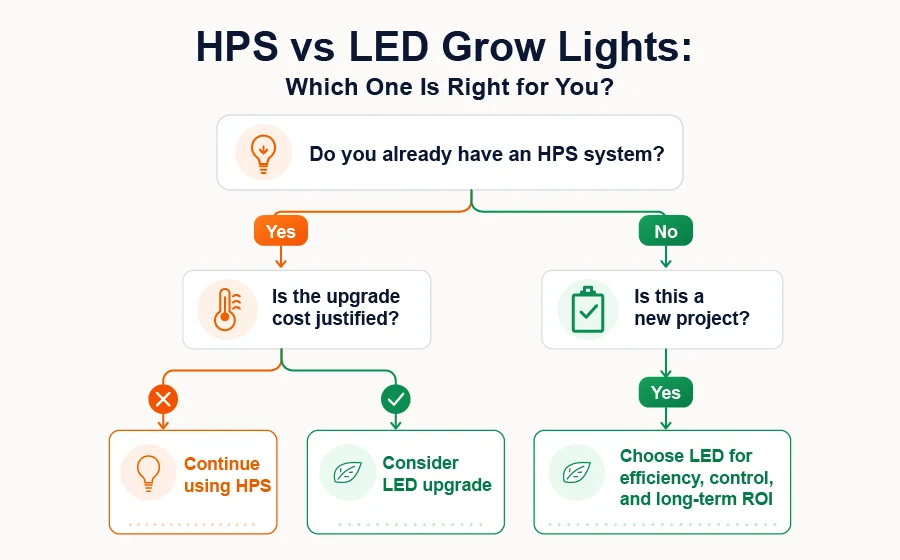
Budget and investment approach: The cost of grow lights is not the only factor to consider when choosing grow lights. Other factors that are important in the investment decision include electricity costs, maintenance needs, and climate control costs. If the project has a small budget or a short-term objective, it may be more significant that the initial investment is less. For longer-term operations, however, Total Cost of Ownership (TCO) may be more useful.
Growing environment and existing infrastructure: Factors such as growing space, ambient temperature, and ventilation or cooling conditions can all influence the actual performance of a lighting system. If a mature HPS lighting setup is already in place, the cost of upgrades or system replacement should also be included in the overall evaluation, rather than comparing fixture performance alone.
Technical operation capabilities: HPS systems are relatively easy to use and learn, making them a good choice for beginners who are new to cultivation and want a simpler setup. LEDs, on the other hand, have more sophisticated capabilities like dimming and spectrum control. These functions offer more flexibility, but they also demand some lighting management expertise to make the most of the advantages.
Quality and yield goals: LEDs offer more control options if the objective is to optimize crop quality by better management of lighting or to optimize the performance of specific compounds like cannabinoids and terpenes. However, for those who prefer a tried and tested cultivation method, HPS could still be a good option because of its commercial use for a long time.
Conclusion
HPS and LED are not simply replacement options for each other. Instead, they serve different growing needs and operating models. With the continuous improvement of plant lighting technology, more growers are no longer paying attention to the price of the lighting system, but to the long-term value of the lighting system. Whether you are looking for grow lights for a greenhouse, indoor farm or any other plant cultivation project, Casyoo has a variety of high-efficiency LED grow lighting solutions that can be configured to various crops, growing environments and project needs to help you achieve more stable, efficient plant lighting.