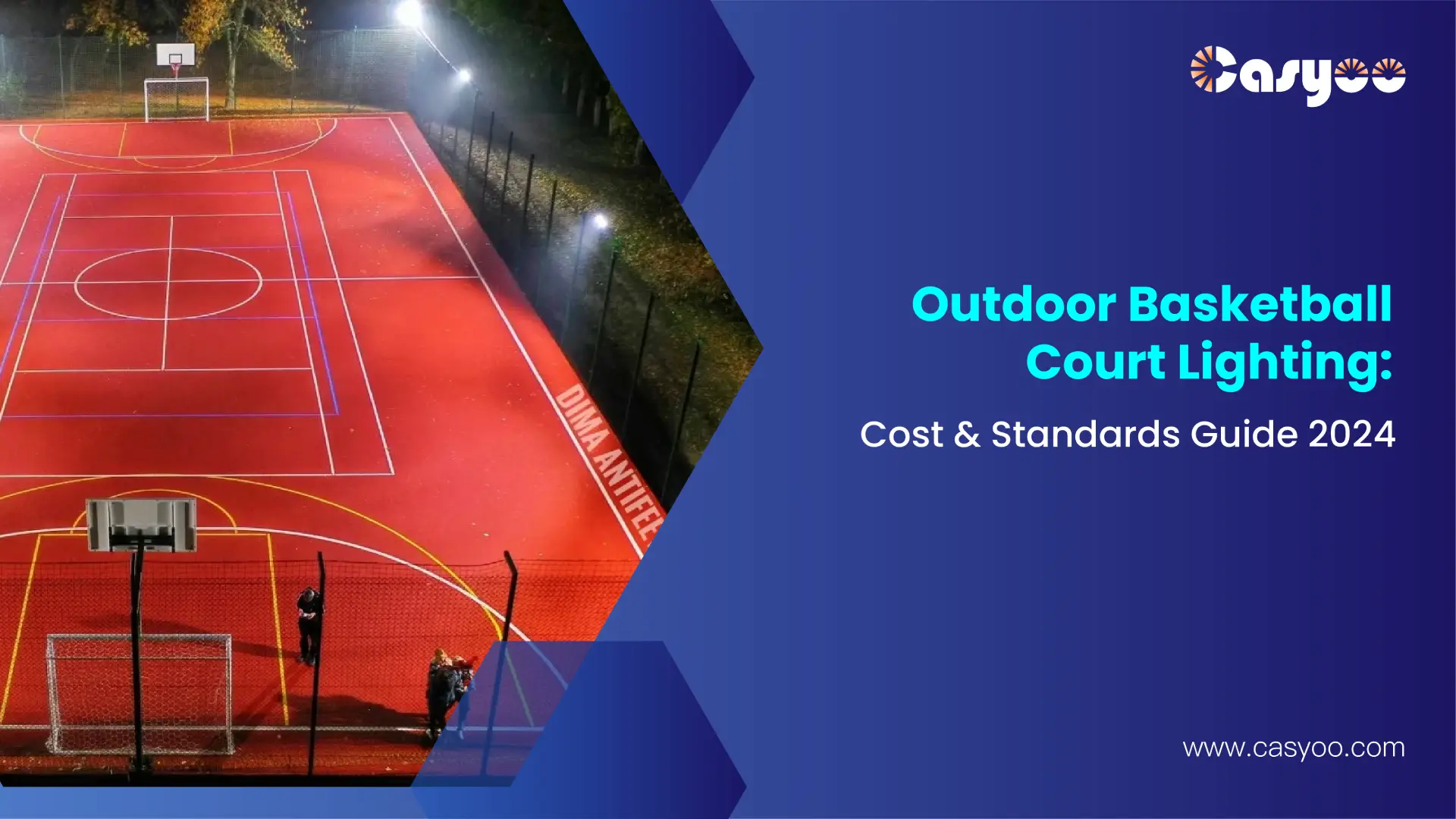
Outdoor basketball court lighting costs in 2025 vary widely because “cost” can mean two different things: fixtures-only pricing or a turnkey installation that includes poles, foundations, wiring, controls, and labor. At the same time, meeting a target lux level is only part of the job—uniformity, glare, and spill-light control determine whether the court feels comfortable to play on and acceptable for surrounding neighbors.
This updated guide explains recommended lux targets by venue type, how 4-pole vs 6-pole layouts affect performance and budget, and what items drive total installed cost. Use it to scope your project and request accurate quotes.
What is the cost of lighting an outdoor basketball court?
The cost of lighting an outdoor basketball court varies greatly depending on your requirements and competitive level. Outdoor basketball court lighting cost depends on whether you’re pricing fixtures-only or a turnkey installation (fixtures + poles + foundations + wiring + controls). As a quick reference, turnkey projects can range widely by competition level, while entry-level fixture packages may look much lower on paper. Use the lux target (200/500/750/2000) and pole layout (4 vs 6 poles) to build a realistic budget before requesting a photometric plan.
For leisure courts, a simple system of eight 100W LED bulbs costs roughly $4,000 and provides 200 lux illumination adequate for casual play. High school facilities normally invest $10,000 for twelve 150W LED bulbs that provide 500 lux. Professional venues demand more advanced systems, which cost $20,000 or more and use fourteen 200W bulbs to provide 750 lux illumination. Broadcast-level lighting necessitates eighteen 400W bulbs providing 2000 lux, with costs beginning at $30,000.
You may have a question: Why cost estimates vary so much?
Two quotes can look wildly different because “cost” may refer to:
- Fixtures-only: luminaires (and sometimes brackets) only
- Turnkey installed: luminaires + poles + foundations + trenching/conductors + controls + commissioning
Your project level (lux target), layout (4 vs 6 poles), site civil work, and controls strategy typically drive the final installed budget.
These estimates cover mounting poles, brackets, wiring, and control systems. While the initial investment may appear high, LED systems often pay for themselves in 3-5 years through lower energy and maintenance expenses. Daily operating costs range from $0.50 for recreational setups to $4.30 for broadcast-level systems, assuming a 4-hour daily usage of $0.15/kWh.
Contact our engineering team today for detailed pricing on our professional LED lighting solutions designed just for your court. We’ll work with you to build the ideal lighting system that fits your budget while achieving all necessary illumination standards.
Standards and references to align with in 2025
Outdoor sports lighting is usually designed according to recognized guidance, plus any project-specific league or municipality requirements.
If your project is tied to a federation (e.g., tournament play), keep those requirements—but clearly state whether you are designing for recreational play or competition/broadcast. This prevents over-lighting and overspending.
Understanding Basketball Court Lighting Standards
Let us get technical. The International Basketball Federation (FIBA) has set strict regulations for court illumination. These rules assure excellent playing conditions at all competitive levels.
| EC: Main camera illuminance | EV: Vertical illuminance(alldirections) | EH: Horizontal illuminance | ||||||||
| Avg(lux) | Min/Max | Min/Avg | Avg(lux) | Min/Max | Min/Avg | Min/Max 4x directions | Avg(lux) | Min/Max | Min/Avg | |
| PPA | 2000 | 0.7 | 0.8 | 1700 | 0.7 | 0.8 | 0.6 | 1500-3000 | 0.7 | 0.8 |
| TPA | 2000 | 0.6 | 0.7 | 1700 | 0.6 | 0.7 | 0.6 | 1500-3000 | 0.6 | 0.7 |
Understanding Uniformity Metrics
Basketball court illumination is based on two important uniformity measurements that work together to provide optimal playing conditions. The first is the minimum-to-average illuminance ratio (Emin/Eave), which measures how uniformly light is spread around the court. Consider it a measurement of the overall consistency of your lighting setup.
The second important metric is the minimum-to-maximum illuminance ratio (Emin/Emax), which shows the difference between the brightest and darkest locations on your court. This ratio is very important for players’ visual comfort and performance. Imagine watching a game in which some sections are significantly brighter than others; this is not only distracting, but it can also have an impact on player performance.
Let us consider a professional-level court as an example. With an average illuminance of 750 lux, the minimum-to-average ratio of 0.7 ensures that even the darkest regions are illuminated at least 525 lux. Meanwhile, the minimum-to-maximum ratio of 0.5 ensures that the darkest places are never less than half as bright as the brightest spots.
These requirements work together to provide the ideal playing environment. Players can reliably monitor the ball across the court, reducing eye strain and fatigue during extended games. For aired sports, these homogeneous lighting settings assure high-quality video recording with no harsh shadows or too bright areas.
Key Lighting Metrics: What Really Matters
Power Requirements and Coverage
Have you ever pondered why some courts seem more professional than others? It’s all about how light is given and measured. A regulation-size outdoor court spanning 28m by 15m normally requires four to six LED fixtures rated at 300-400W each. The overall system wattage typically ranges from 1200 to 2400W, depending on the amount of play desired.
Light Distribution and Uniformity
Uniformity is critical to player performance and safety. A uniformity ratio of 0.7 or above, which indicates that the minimum illuminance is at least 70% of the average, is the goal of professional installations. This results in a consistent playing environment in which players can precisely track the ball and judge distances from anywhere on the court.
Color Quality and Temperature
Player performance is significantly impacted by color quality. We use fixtures with a Color Rendering Index (CRI) of 80 or better, guaranteeing that players and equipment show in their true colors. The color temperature typically ranges from 5000K to 5700K, resulting in daylight-quality illumination that helps keep players focused and energetic during the game.
Technical Design Guide: Getting It Right
Pole Configuration and Light Distribution
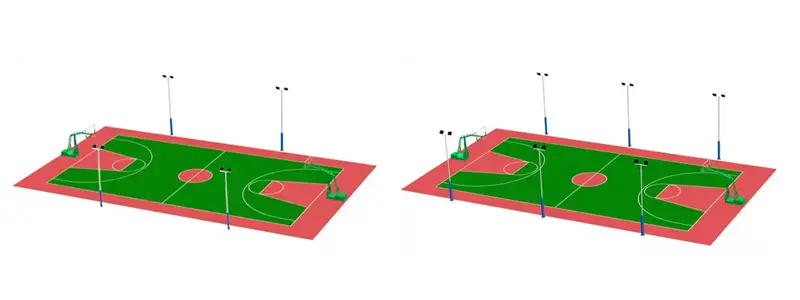
For professional outdoor basketball court lighting, we recommend two established setups that mix optimal illumination and cost-effectiveness:
Professional Solution (6-pole configuration):
- Place three T-shaped light poles on each long side of the court
- Center pole: positioned on the court’s centerline
- Corner poles: placed 4.5-5 meters from the end line (short side)
- Distance from sideline: 2 meters for player safety while ensuring sufficient illumination
- Pole height: 6-8 meters (20-26 feet)
Economical Solution (4-pole configuration):
- Place two poles symmetrically on each long side of the court
- Position poles 5-6 meters from the end line
- Maintain 2-meter distance from the sideline
- Pole height: 6-8 meters (20-26 feet)
Environmental Protection
Weather protection is another important factor with outdoor installations. Professional-grade fixtures have an IP66 rating, which ensures protection from heavy rain and dust. We recommend that courts in coastal locations have additional anti-corrosion coating to guard against salt air exposure. This attention to environmental conservation ensures that your lighting system continues to work well for many years.
Installation Best Practices
Foundation and Wiring Considerations
Outdoor court lighting installations must have underground wiring installed in conduit at a depth of at least 24 inches below grade, according to the National Electrical Code (NEC). This depth requirement provides protection against physical damage and environmental causes while adhering to national safety regulations.
Pole foundations require careful engineering in accordance with ASCE structural recommendations. The basic rule for foundation depth is one-sixth of the pole height, however specific needs may differ depending on local soil conditions and wind load estimates. For final requirements, always consult with a structural engineer and local construction codes.
Backup Power
For sports and recreational area lighting, use ANSI/IES RP-6-24 as a current baseline reference (along with project-specific league requirements). For EU/international projects, EN 12193:2018 is commonly used for maintained illuminance, uniformity and glare considerations. For spill light and environmental impact, refer to CIE 150:2017 and related obtrusive-light guidance.
- For specific installation requirements in your area, consult:
- Local building codes and permits
- Regional electrical codes
- Site-specific structural engineering reports
- Local utility company requirements
Operating cost calculator (simple and defensible)
Daily energy cost can be estimated using:
Daily cost = (Total watts / 1000) × hours/day × electricity rate ($/kWh)
If you want a conservative default for U.S. audiences, EIA annual averages (e.g., “All sectors” vs “Residential”) provide a reference point, then users can replace with local utility rates.
Example (replace inputs):
- Total watts: 1,800W
- Hours/day: 4
- Rate: $0.129/kWh
- Daily cost: (1800/1000) × 4 × 0.129 ≈ $0.93/day
Taking the Next Step
Selecting the appropriate outdoor basketball court lighting system is a substantial investment that affects player performance, safety, and long-term operational expenses. Every detail counts when it comes to establishing the ideal playing environment, from understanding FIBA regulations to selecting the proper fixtures, skilled installation to continuous maintenance.
Expert guidance can make all the difference, whether you’re constructing a new installation or renovating an old facility. Our team of LED sports lighting specialists can assist you:
- Create a lighting system that satisfies your unique requirements.
- Select fixtures that deliver optimal performance while maximizing energy savings
- Make sure your installation complies with all applicable local codes and standards.
- Create a maintenance schedule that safeguards your investment.
Are you ready to alter your basketball court? To schedule a free consultation, please contact us!